What motivates me in my leadership role? This was asked of me recently, and as I reflected, it seemed to me that there are three different aspects to how I would frame things.
Character
At the core of leadership, some integrity of character is needed. People need to know where they are with you, and it is no use rolling out a vision or goals which are at odds with what people see expressed in you. So there is something about who I am which motivates me, drives me to live out and express a vision deriving from my own character and how my faith has grown. This kind of authenticity is important in leadership, so in one sense, being myself (and seeking to become a more Christlike version of myself as I grow in faith) underpins my motivation.
Vocation
A sense of vocation not only in myself, but my belief that everyone has a vocation is another key driver. Ultimately, all humans have a vocation to flourish (and the Christian faith has a lot to say about that!). But more specifically, all followers of Jesus have a vocation to become disciples of Christ, to love God and love their neighbour, to share the Good News of God’s Kingdom and to live and work to God’s praise and glory. This is something done in community, not a solo pursuit, and so helping people navigate their own calling as a Christian as part of the church community is a key part of the leadership role of a parish priest, or indeed anyone, lay or ordained in a ministry role. I am motivated by the joy of seeing someone come to faith, grow in faith, or discover new talents and passions for areas of ministry they might never have considered, but which a vision-led church community can enable.
Vision
There has to be vision in leadership, but if the vision is only that of one person who has not engaged in creative dialogue with the church community and the wider culture in which that community operates, as a key part of forming the vision, the chances are that this is a vanity project, not something led by the Holy Spirit. The Church is an expression of the ministry of the Spirit, something communal in which everyone has value, everyone matters, and where everyone is called to play their part. A leader is one part of that community, but cannot lead in a vacuum because we are all baptised in the one Spirit, and it is only by being attentive to how the Spirit is at work throughout the whole church community that a coherent, Spirit-inspired vision can emerge. Yes, it also must be rooted in Scripture, and consistent with the wider vision of the Church, but vision emerging from how God is already at work and equipping his Church is what a leader needs to discern. Then communicating that vision, inspiring everyone to engage with it and pray about what part they might play in it, embedding it into the whole life of the church community, and ensuring the leader is affirming how the vision plays out by remaining connected to how the vision grows is all part of ensuring, as leader, that the vision is kept in sight as everyone lives it out. The idea of playing my part in leading a church into that process is a huge motivator for me as a church leader.
Are the three aspects I chose the same as what you might choose?
How do you keep your long-term plans refreshed? I ask this as someone keen to learn from others in leadership positions in different fields to my own (i.e. church ministry).
Identifying which voices to engage with is a key skill.
A key aspect of this for me is active listening to the people who are already involved and invested, or whom I have “talent spotted” as people with potential to be nurtured as key people. But when many of these folk are volunteers with busy lives and differing capacities of available time and energy, it can be hard to get a clear picture quickly without mainly engaging with the most available (or loudest) voices. The advent of AI has made this challenge harder as one can find oneself reading a massive screed from a stakeholder in a project which at first glance looks well-developed but has not had the hard graft of a human thinking things through before you are presented with it, so it soon proves inadequate as a starting point for taking things forward without you as leader having to unpick it all and do the actual mental work! Finding strategies to engage with less available but equally valuable voices is important, as is how to engage with the over-thinkers in a way which is neither exhausting to you, nor comes across as dismissive and evasive to them!
Getting external help is one tool. In my world, this means Diocesan advisors who have proven invaluable through convening workshops, providing resources, or making presentations to our deanery synod (the deanery being our more local network across a smaller region than a diocese). Another way has been by engaging with materials and processes from bodies such as CPAS or LiCC, or having books to guide us (e.g. Margaret Pritchard Houston’s “Beyond the Children’s Corner” when strategically reviewing our ministry with children).
Engagement and follow-up to external input is important.
Whilst these are great in providing impetus and focus, the real work comes through engagement and follow-up. I take the view that, with limited personal resources as a leader, it is more often a case of meeting energy with energy. By which I mean, when I see energy and engagement from someone, I come alongside, nurture it, encourage it and provide an overseeing eye, or co-lead. Yes, sometimes the initiating and major energy needs to be my own, especially when one is nurturing the growth in faith of someone who might not have put themselves forward as an initiator of a project, but in a setup as complex as a multi-church group spanning different communities, meeting a variety of social and cultural needs, and requiring engagement at several layers all at once, a leader who tries to do all the heavy lifting alone (even with a token bit of delegation) will soon do the spiritual equivalent of putting their back out and be ineffective. It is also a poor model of Church. Developing everyone’s vocation as a follower of Jesus is a key part of the core role of a vicar or church leader.
Many of my volunteers have a wealth of experience from their world of work, or other volunteering activities, and giving space for others to lead where their competence exceeds my own is part of the skill. Triaging shared leadership is a skill in itself, requiring by turns humility, discernment and occasionally having the strength and will to stop someone getting their own way simply because of their strength of character and determination to have their own way when this is not necessarily the direction the whole community needs at that particular time. And navigating that can be a hard call!
My annual retreat to Holy Island in Northumberland is crucial to my leadership.
In terms of keeping my own leadership fresh, my annual retreat to Holy Island is key. That period of stepping away and active reflection in a place of quiet contemplation with a companion to reflect with is absolutely invaluable. This means I return with renewed perspective, ready for conversations, for coming up with a process for revision, planning and longer term consultations with a fresh sense of personal vision as a leader.
There is so much more to say and unpack, but I wonder…
How do you navigate these aspects of strategic leadership in your industry or ministry?
Cast your mind back to the end of 2016. It had been quite a year: Brexit, the first Trump presidency was underway, the concept of living in a post-truth world was upon us, many well known people from the creative arts had died and there was a sense of living through a pivot point of some kind. On a personal level, I had been ordained priest in the summer, a new phase of ministry, so perhaps the sense of a new era was particularly resonant for me.
Since then, AI has added to the sense of truth being elusive. Certainly over the past 9 years we lived through a series of episodes which show my concerns at the end of 2016 about truth in public life were well founded. We had Mr Johnson in 10 Downing Street, a serial liar, bounder and chancer, whom many were seemingly happy to hold to a very low bar of accoubtability for his mistruths. The rot of 2016 had borne bitter, fatal fruit.
We have seen our national broadcaster editing footage of Mr Trump in a misleading way (when they could have perhaps made the same editorial point in other valid ways without playing fast and loose with the video editing). This also undermines trust in the truth of what people can learn via mainstream media now, let alone the wild west attitude to truth when it comes to unregaulated online sources.
And we now have AI which is in danger of ruining our ability to think, research and share truthful data online whilst promising a future where the wonder of human creativity can be done away with. I hold out a hope in the latter case that this will lead to a backlash revival in live music and other art forms, and maybe take creativity and the way it works economically offline and back to a more human and social level again, but we’ll see.
Perfect love casts out all fear. That was the punchline of my 2016 musical musing. This was not a bad song, but was not well performed due to ill health. The song tried to set out some of my hopes for 2017, and I wrote this on one of my social media posts where I shared it:
“As we head towards the last weekend of the year, I continue to hope and pray that love not fear grows, that truth trumps the normalization of political lying, that people of love find their voices and encourage one another, and that we cling to hope, come what may.”
So as 2025 ends and 2026 begins, the sentiment still resonates. Have a listen.
Thank you Lord for the parish ministry you have called me to; for the souls whose cure is my duty, calling and life.
Bless those whose encouragement blesses me, who recognise my weaknesses and limitations and without putting me on a pedestal, see my frailties and gently bear me up.
Bless those who work beside me, who share the yoke of ministry; who assure me that this work is that of the body of Christ, not just my weak, all-too-human self.
Bless those who stay too long or too often, who are self-obsessed, who have little in the way of self-awareness, or who seek to monopolise my time: for their reminder to me that my time is no more valuable than theirs in your sight.
Bless those whose bitterness, hatred or self-righteousness lead them to attack me (or you); may Jesus walk beside me as I walk beside them, and help me be as wise and gracious as him.
Bless those who mourn, for the privilege of becoming part of their story as I help them say their farewells at a funeral or burial; I am but dust and ashes, yet as precious in your sight as they and those they grieve.
Bless those who steal from the foodbank collection, for the story which lies behind this affront to the charity of others; yet give me wisdom to marry love with justice in my response.
Bless those who see through me when I am out of my depth and are kind. Lovingly kick me up the backside, Lord, to get on with it and trust in you. In your strength, not my own, help me swim with good grace.
Bless those for whom I am a seeming irrelevance, who could not care less who their vicar is. Remind me that a vicar is one who acts ‘on behalf of’ – vicariously. May I ever be mindful that I act and am visible in my community on behalf of Jesus, my Saviour and the healer of the souls committed to my cure, and of my soul also.
I’ve been musing on some of the ‘leadership modes’ we inhabit as clergy. I have never bought into the idea that a vicar should have just one, easily-definable ‘leadership style’, nor that we must inhabit a single style based on our alleged ‘personality type’. So the following is by no means exhaustive, and these are not binary choices, more an aid in reflecting on the most apposite mode to adopt in given situations. And at best, these are mere self-check questions, not a system for how to lead! I think we are naturally drawn to one or other of these modes of leading, but a healthy leader should have some kind of self-awareness and be reflective, learning from how one reacts instinctively to enable us to adopt the most apposite response, even if it wouldn’t be what came naturally. This is, of necessity in a short online post, over-simplified, but I hope it gets people pondering.
Perspective: How am I seeing the presenting situation? This can be broad or narrow. Does the situation require vision for the future or pragmatism right now? Which is the more important focus? And how is this to be communicated? Pitfalls: visionary = fantasist; pragmatist = overthinker
Perception: How am I responding to what is going on? Is a focus on depth or clarity paramount? When I lead others, do I need to show mainly confidence or sensitivity so as to take people with me pastorally? Pitfalls: confidence = self-promoting/pride; sensitivity = self-indulgent/overthinking
Pastoral: Do people most need a shepherd, teacher, prophet, confessor, travelling companion, ‘parent’, or some other archetype of pastoral leader right now? These archetypes overlap significantly or course. Key questions: what aspect of Jesus might people see in me through how I lead on this? How am I helping people discover their vocation as disciples? Do I need to make myself inhabit a role here, or is the mode one I find natural? Pitfalls: being inauthentic by trying to fit a Biblical archetype too narrowly.
Inner / outer focus: Is a more introverted pondering needed, or a more extroverted bit of action needed right now? Kick any sense of your MBTI type ruling your approach into the long grass right now! You need to be able to operate in either modes at different times. If you know you are more prone to introversion / extroversion, just factor that into the mix but never use this as an excuse not to embrace the ‘other’ mode as you will be a poorer leader for it. Pitfalls: introversion = too much ponder/being or seeming withdrawn; extroversion = too little ponder/overbearing
Voice: Do people need to hear words of challenge or comfort? Is my presence paramount, or my words? Do I need to reveal more of myself, or rein that in to give them more space to occupy in the conversation? Is silence (or fewer words) the mode needed? Do they need me first and foremost as Nick or as a priest (less of me: a sacramental presence)?
Prioritizing outcomes: Do I need to focus on relationships, the process and connections (the journey there) or the outcome, a sense of the job being done / completed and off the To Do list? You have to be aware of both, but setting a priority, especially at the outset is helpful, but it is also worth going into every meeting, or new stage of things with this in mind. Pitfalls: journey = lose focus on the outcomes; completion = no pastoral focus.
Choose a framework / mindset: related to the above, do I need to be organised and methodical for this, or is a more flexible, improvised approach going to be the best for the people involved / the task / project? Pitfalls: organised = too rigid, less room for individuals to thrive and grow; too improvised = chaotic.
And finally, Reflections on the way, or on completion:
Where were the opportunities for rejoicing, worship, prayer, sense of God’s presence with us? What glimpses and insights into people’s journeys of faith did I gain? What have I learned about myself as a child of God?
When we talk about church growth, our first thoughts are often about growth in numbers, in amount of activity, in hours of engagement, and alongside this what we might term growth in discipleship, in depth of understanding, Biblical literacy, and developing habits and behaviours which are in keeping with what we aspire to be as Christians. All those things are good in themselves, but they don’t tell the whole story. Alongside growing, we need to be mindful of our health. As teenagers grow physically, having healthy patterns of life, getting a good, balanced diet, and developing a positive but not narcissistic self-image are of importance in their growth into adulthood. Healthy people grow well, and for someone like me who is in his 50s, the habits I build now and my approach to my health and fitness now is something that 80 year old me may well thank me for in the 2050s! The same principle applies when we consider church growth. Healthy growth is the key, not just growth in numbers and activities. After all, in the human body, growth without health can lead to problems. In my case, I had non-cancerous bone growths in my spine which started to cause me problems in recent years. Growth was not a good thing in that instance, and unchecked could have left me in constant pain, physically weak, and my limbs impaired. The surgeries I received, and the rehab and physiotherapy afterwards put the impact of this unhealthy growth behind me.
Church growth vs Church health
A healthy church should grow. But the health we need to develop in church communities goes beyond talk of numbers, or how many groups we run, how many activities we see. We need to ask questions about the health of our church communities which address relationships, culture and ethos, as well as emotional and spiritual health.
Can we disagree in a loving way? Can we resolve our conflicts in a way which others would look at and say “See how they love one another”?
Is our culture of Safeguarding so deeply embedded that we are a genuinely safe and loving environment where everyone can safely grow and thrive in their faith, and find their place in God’s family?
Is our church culture complacent? Do we challenge ourselves and ask whether we are as welcoming and inclusive as we think we are? Are we open to change, and do we do what we do for God’s glory or to pat ourselves on the back and feel comfortable in our own holiness and self-righteousness?
Are people who are emotionally vulnerable, intellectually challenged, suffering from dementia or living in the aftermath of trauma being properly cared for, nurtured and protected? Are they being affirmed and empowered as well as ministered to? Is our church a place of healing for them where they can gain strength from the love and support they receive, and discover their own vocation as God’s children?
Are people in our church community truly rooted in Christ, being nurtured as his disciples and able to see their church activities and attendance in terms of their “theosis” – i.e. their transformation into the likeness of Christ?
Are our clergy and lay ministers in risk of burnout? An experienced vicar once said to me, a couple of years after my ordination, “Nick, when you talk about your ministry, I hear a lot about how you are pouring yourself out, but not a lot about how you’re turning the taps on to fill the bath back up. Make sure your bath doesn’t run dry.” We need to make sure, as ministers that don’t simply distract ourselves with rubber ducks, but turn on the taps. By this I mean, not just finding hinterland hobbies and occasional distractions from the pressures of ministry, but ensure we have space for genuine refreshment and spiritual nourishment. And if you are a vicar, it is your churchwardens’ duty to make you do this too: your health and wellbeing is part of their remit, so have regular conversations with them about this. Battling alone is not healthy in itself, and vocation and calling is never a wholly solo pursuit. Part of being a healthy church is taking shared responsibility for each others’ wellbeing, and in the case of clergy and other church leaders, an example has to be set from the leadership, and the leadership supported in this.
There are pressures, often of our own making, in ministry: pressure to perform, deliver, produce new things, develop everyone else’s vocations, keep the show on the road, dealing with everyone else’s crises and challenges without considering the cost and weight of all this. Time off, Sabbath time, spiritual refreshment, theological study and refreshing of our passion for Jesus, prayerfulness, retreats, and all the rest are important in terms of self care and spiritual nurturing, but these also should not be yet another pressure we put ourselves under – more things on the To Do List. Clergy and their families can implode under this pressure, and clergy can also pass this pressure on to congregations through their own expectations and demands, or poor delegation and failure to step back and question what is truly important, what is truly the work God is calling our church community to undertake. So part of the health of a church is stepping back from time to time to review the whole ministry of the church community and whether some things have run their course, or cannot realistically continue to be staffed in a way which is healthy for the volunteers and staff involved.
Growth tends to happen gently – though occasionally things take off unexpectedly and quickly. And this is because God nurtures as he calls. When we look at how God calls people in the Bible, there is often a sense of a gentle calling first, which grows. Samuel was quietly helping Eli in small ways as a servant before God called him in the night. And when he hears God’s voice, it is not to call him immediately to be a priest or prophet, but to warn his master Eli that he and his sons are going to be punished for their errant leadership. The calling is firm but nurturing, step by step. This is why, generally speaking, new believers do not immediately step up into leadership or teaching roles in churches, and vocations unfold more gently.
Growing churches is important, but healthy growth is what is needed, growth which nurtures and affirms, and which challenges all members of the church to grow in a way which is healthy, which makes us a visibly safe and more loving community, and which makes us more and more like Jesus.
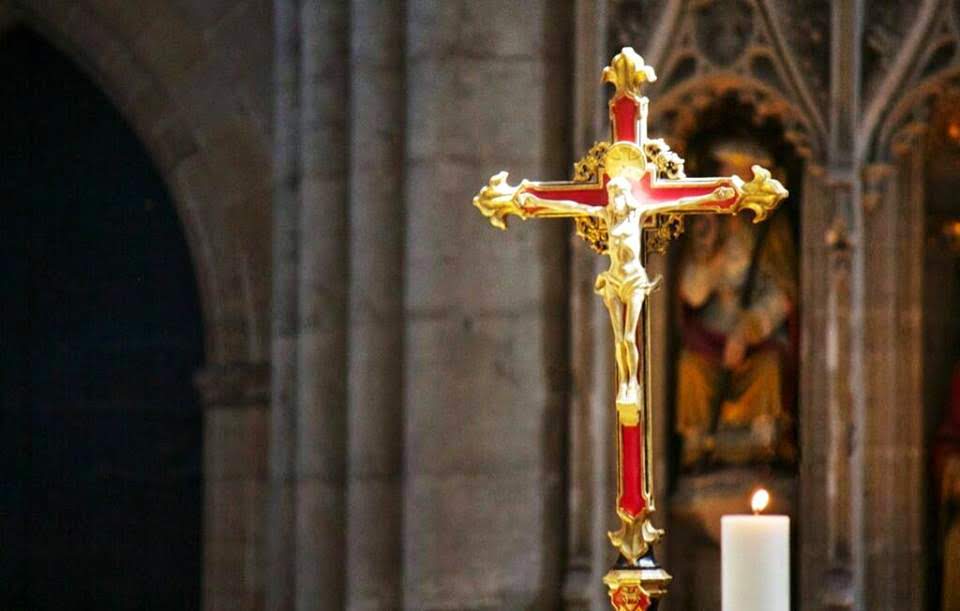
One of my favourite hymns is “When I survey the wondrous cross”, a poignant reflection on the love of Jesus which led him to the cross and which urges us to follow his example of wholehearted love for others. The cross was originally a symbol of oppression and injustice, an instrument of torture and state-sponsored execution by the Roman Empire. The events of Good Friday and Easter meant that this symbol was subverted. Because of Jesus, the cross now is a symbol of hope and love, and stands as the ultimate reminder of the generous heart of God who loved us so much that his Son, Jesus, spread his arms wide on the cross to embrace us all, inviting us to open our hearts to embrace and accept his love in return. The flag of St George, England’s national flag, reminds us of this: red for the blood of Christ, shed for the sake of God’s love for all humanity as he died on the cross, and white for the glory of heaven and eternal life which that shedding of blood revealed.
The processional crucifix at Ripon Cathedral (photo credit: Nick Morgan)
Which brings me to a more recent subversion of the cross as a symbol. Whatever the genuinely patriotic intentions of some of the individuals who participated in the recent flag flying campaign, the result (arguably the intention of those who devised the campaign) was to intimidate minority groups. Online comments, and those of commentators from the far-right of politics show only too well how this display of flags, far from being a patriotic celebration of our nation and national community, is being used as a tool of racism, the cross of Christ weaponised to incite division, and as a cover for outright nationalistic hatred of anyone outside a very narrow definition of Englishness.
Stained glass window depicting St George and his flag, All Saints’ Church, Bramham, the motto ‘Greater love hath no man this’ designed to inspire worshippers to acts of self-sacrificial love.
Our national flags should be a source of pride – indeed, they are flown from our churches on occasions of national significance and paraded on Remembrance Sunday as symbols of national unity. I do not believe that the recent campaign serves this purpose. While some who promote the campaign say they only wish to promote patriotism through their actions, the reality is that the way in which our national flags, especially the flag of St George, are being used to vandalise monuments such as the White Horse of Kilburn, or roundabouts, or being flown (often half mast!) from lampposts, bridges and elsewhere does the very opposite of promoting national cohesion. The intention is to tell some people that they do not belong, that they are not welcome. The fact that the Cross of Christ is the key symbol of our national flags means that, as a Christian, their use matters to me. Any use of the Cross of Christ as a tool of oppression, exclusion, or of making people feel unwelcome is a blasphemy. It takes the meaning of the cross back to its Roman origins: to use it as a tool of fear and division, the very opposite of the Cross of Christ which stands, red on white on the flag of England. Yes, I am uncomfortably aware that the flag of St George was used by the Crusaders in medieval times, and that their actions did much to damage the mission of the Church through the atrocities which were committed in the name of Christ under the banner of this very same cross. And yes, that was endorsed by the Church at the time. So we must learn from past mistakes, repent, and not let the cross become synonymous with hate, division, violence, exclusion and injustice again. Turning from past mistakes is the very definition of repentance and is part of the Christian path of redemption which the Cross points us towards.
I am proud that, in our diverse nation, our flag bears the cross of Christ, a symbol of Christ’s love in the face of evil, and his defeat of sin and death. We will continue to proudly welcome our nation’s flags into our churches on Remembrance Sunday and fly them on national occasions as symbols of our Christian heritage as a nation, a heritage which should inspire us to acts of love, justice, peace, hope, welcome, forgiveness and inclusion. As you look at our flags, wherever they are flown or displayed, I hope these values are what you choose to see and be inspired by, because they are the values we should aspire to as a nation, values revealed through Christ and his cross.
A sermon given on the Feast of St Peter and St Paul, Sunday 29th June 2025, the day after The Reverend Hannah Moore (my curate) was ordained to the priesthood at Selby Abbey.
The Feast of Peter and Paul is an ideal one on which to think about our vocation as Christians. Both these saints had a clear vocation: they were Apostles – messengers of the Gospel – and in that role anointed others to minister in the early church. Yesterday evening, many of us were in Selby Abbey as Bishop Flora continued that aspect of the Apostles’ ministry. Early on in the life of the Church the role of Apostle developed into that of Bishop – an overseer of the Church, and one who lays hands on others as they are commissioned into ministry. And so it came to pass yesterday that Bishop Flora laid hands upon Hannah, poured oil upon her head and anointed her for service as a priest in the Holy Catholic and Apostolic Church, beginning a new phase of Hannah’s ministry.
In the Orthodox Church, when someone is ordained priest, the Bishop and the people acclaim them by shouting the word “Axios!” three times. This means “Worthy!”. The Bishop and the people thus proclaim that this person is worthy to be a priest, worthy of their new ministry, worthy to administer the Sacraments, and acclamation by the people is a key part of the commissioning of a new priest because – and this is important – the ordination is of significance for the whole Church, not just for the new priest.
Yesterday’s service was a very special occasion for Hannah and those ordained alongside her, but it was special and important for the wider Church as well, especially churches such as ours where newly-minted priests are to minister. Nobody has a vocation in isolation. Just as Hannah is commissioned as a priest to serve among us, so we are commissioned to serve alongside her, partners in the Gospel, allowing her to grow in her priestly ministry, and as a leader, pastor, preacher, confessor, intercessor, teacher, and shepherd among us. We are all of us called through our baptism to shine as a light in the world to the glory of God the Father. but that light is, and has ever been, a communal light. And part of a new priest’s role – Hannah’s role – is to help that communal light to shine.
St Paul: lone wolf?
Take St Paul as an example. Paul can sometimes come across as a superhero – a gifted and somewhat maverick leader who plants churches and has great adventures as he single-handedly spreads the Good News of Jesus all around the eastern Mediterranean. But Paul is no lone wolf. When we delve into the Acts of the Apostles and Paul’s own letters, we learn that he has many travelling companions and collaborators in the Gospel without whom his ministry could not have happened. The list of his travelling companions includes names you may be familiar with such as Barnabas, Silas, Timothy, Mark and Luke, but there are others who only get a mention in passing – Epaphras, Gaius, Onesimus, Sosthines, Aristarchus, Jason, Sosipater, Trophimus, and Tychicus. And then, add to this those who hosted Paul on his journeys and welcomed them into their homes. Add to this the leaders of the Christian communities he left behind or to whom he wrote letters: men like Philemon, Aquila, Erastus, Ananias and the splendidly-named Dionysius the Areopagite! And women like Junia, Phoebe, Priscilla, Damaris, and Lydia. And there will be countless more who are never namechecked in scripture who played their part in Paul’s ministry.
It is sometimes said that it takes a village to raise a child. By the same token, it takes a church to raise a priest. We are the church communities where Hannah is being raised as a priest. And this is not only true of priests: it takes a church community to raise a disciple – each and every disciple. God calls, disciples respond and follow, and the Church nurtures that spark of individual faith into a flame that grows, glows, warms, enlightens, and inspires the world with the Good News of Jesus. That is our communal calling with one another. That is what yesterday’s service means for us, Hannah’s church family, as we nurture the flame of her priestly ministry here, and as she in turn nurtures our discipleship. Our churches must be places where each of us can grow in faith, and our vocation as the people of God can grow and flourish.
One of our church schools, St Mary’s in Boston Spa, has been on something of a journey in recent years. It has developed rather wonderfully, and embedded in this success has been the renewal of the Christian vision of the school. My own experience is that St Mary’s school is a lovely place to visit, an excellent learning environment, and a wonderful community to be a part of as their vicar and as a governor.
I mention this because of their school vision which I think our churches would do well to reflect upon and seek to emulate. The vision is this: Together we inspire and nurture so that everyone can flourish. That statement, rooted in the vision of the Mustard Tree which Jesus spoke of as a model of the Kingdom of Heaven, is also a vision of what the Church should aspire to. It represents a place where, from the tiniest seed of the Gospel, a mighty tree grows, a tree in whose branches all the birds of the air can find a safe place to be nurtured and flourish. It is a vision of inclusion, of safety, and of being surrounded by the truth of the Gospel: the truth that God is not distant, but is with us, all around us as our dwelling place here on earth, right now. You see, our aspiration as followers of Jesus is not that we might go to heaven when we die. A mustard tree’s roots are in the soil of the earth, not the clouds above. And so our aspiration is that we continue the ministry of Jesus here on earth, that our faith is nurtured into the living reality of living like Jesus so that things on earth might be as it is in heaven.
Together we can live out this truth in our church communities. We can be inspired by seeing Hannah’s calling blossoming into the living reality of her priestly ministry among us. We can be inspired by seeing St Mary’s School grow into a place where a vision rooted in the love of God inspires the flourishing of the whole school community. And we can live out these four truths:
that God the Father is not distant in heaven but lives on earth among his people, a loving Father among his family
that God the Son is alive and still active here on earth, bringing justice, healing, hope and love through his Church
that we are a loving community in whom God the Holy Spirit dwells; believers who live out the Gospel together, inspired to extraordinary acts of love, welcome, grace and generosity
and that we are people whose resources are at God’s disposal, whose time and gifts are used to God’s glory, and whose money is given generously to the ministry of his Church.
A priest stands among the people as a living reminder of God’s grace. As Bishop Flora told us yesterday, a priest is a living Sacrament. By inhabiting the ministry of priest, Hannah is called to be a sign of God among us, a living Gospel flame – a beacon of God’s goodness and grace to all humanity. But every one of you is a living Gospel flame as well: called to be an embodiment of God’s goodness, and of the Good News of Jesus. We are called, communally, as God’s family, to be God’s blessing in the world, called to pray for the world, to seek God’s will, to live out God’s justice, peace, grace, hope and love as church communities together.
You may not feel worthy of that calling today. Perhaps you think all this is for the holier folk, those more able to articulate their faith, the ones who have more obvious gifts, more visible gifts to offer in God’s service. People like Hannah. She does an excellent job of modelling her calling as a disciple of Christ, and now also as a priest in God’s Church. But the Good News is, that just as Hannah is worthy of her calling, you are worthy of yours as a child of God and as a follower of Jesus. That word again: Worthy! Axios!
So let us celebrate the fact that God has called Hannah to the life and work of a priest among us, just as God called Peter and Paul as his Apostles, and just as God calls each of us as disciples. Hannah, please stand at the top of the steps where we can all see you and acclaim you as worthy of your calling as priest. In fact, everyone please stand.
Hannah, we welcome you to priesthood in God’s Church here in these parishes. We, your church family acclaim you as a priest among us. We will serve the Lord alongside you here. We find you worthy, indeed. I therefore invite the people of God gathered here to echo this threefold acclamation after me.






 Vicar of Villages