On earth as it is in heaven?

Pentecost 2026

On the day of Pentecost, something extraordinary happened. The Holy Spirit fell on a room full of frightened, uncertain people, and suddenly they found themselves speaking in languages they had never learned. And the crowds outside were astonished, not because everyone was saying the same thing in the same way, but because each person heard the good news in their own language, the voice and cadence of home.

The Holy Spirit honoured every language, every people, every place of origin. Parthians and Medes, people from Mesopotamia and Cappadocia, visitors from Rome and from North Africa, all hearing the same message, each voiced in a way which was familiar to them. Difference and diversity was not the problem. Diversity was inherent in how the Spirit chose to speak.

So this is where the Church begins: not with uniformity, but with a Spirit-filled community that holds together people of every nation and background.  And then, watch what happens next: as the weeks and months unfold in the early chapters of Acts, we see what that Pentecost community becomes in practice.  St Luke gives us two pictures of this, in chapters two and four of Acts.  All the believers were together and held everything in common. They sold property and possessions to give to anyone who had need. They broke bread in each other’s homes and ate together with glad and sincere hearts. There were no needy people among them, because those who owned land or houses sold them and brought the proceeds to the apostles, to be distributed to anyone who had need.

This is a community defined by how it loves and shares, not by who it excludes.  It crossed every social boundary of the ancient world. Wealthy landowners and day labourers; Jewish believers and Greek converts; men and women; the respectable and the marginalised, all held together by a common life rooted in the love of Christ.  And everyone notices!  Luke tells us they enjoyed the favour of all the people.  There was something visible, something distinctive about this community: you could see, from the outside, that something different was going on here. People were being cared for and nobody was being left behind.  The vulnerable, the widow, the orphan, the stranger, they all had a place at the table.  This is what the Holy Spirit produces.  Not just a warm feeling when they gather in worship or prayer, but a whole new way of living together.

Now, I want to make a connection that might surprise you, and I want to make it carefully lest I be misunderstood.  It involves a loaded and often divisive word: nationalism.  The Christian community we see emerging from Pentecost in the Book of Acts is a picture of what human society, at its best, is meant to look like.  And when we talk about nations, about what a nation is for and what holds it together and defines it, the Acts vision has something urgent and important to say in answer to the growing tide of nationalism around the world, including in our own country.

We have watched versions of nationalism grow, versions that are built on fear, on grievance, on the idea that our nation can only thrive if we define ourselves against someone else, the immigrant, the outsider, the other.  We have seen nationalism weaponised by politicians and influencers who wrap themselves in religious imagery while pursuing agendas of exclusion and division.  That version of nationalism is rightly challenged by followers of Christ as it is entirely at odds with the ministry of Jesus and the Holy Spirit-inspired Pentecost community of inclusion, empowerment and love which we celebrate today.

But this is not the only vision of nationhood and nationalism available.  If by nationalism we mean a way of defining what makes us cohesive as a nation, what our shared values and vision are, what both the breadth and the limits of our sense of nationhood are, Christians have, in the post-Pentecost community of believers, a wonderful model to draw upon.  And we, the Church, as people inspired by that same Spirit, absolutely must stand up for that vision in times like these.

Earlier this year, the former Bishop of Leeds, Nick Baines, published a substantial and thoughtful report called Reimagining Europe.  It is a serious piece of work, and I commend it to you.  In it, Bishop Nick makes a careful argument that nationalism, properly understood, is not inherently destructive. He points out that civic nationalism, a shared sense of belonging rooted in common values, mutual obligation, and the rule of law, has provided the foundation for democracy, for the welfare state, for public education, for all the institutions that exist to serve the common good rather than the powerful few. This is a nationalism which gives a sense of belonging, interdependence and shared values; a national identity which makes for a stable, safe society in which all may flourish within a clear legal and constitutional framework.  The problem, he argues, is not nationalism itself, but the ethnic, exclusionary version of nationalism which hijacks the language of national identity for its own narrow purposes.

Bishop Nick goes further.  He says that Christians are particularly well placed to offer a different vision because the Church, at its best, is already a community that holds together people of every background in a common life shaped by shared values.  Church communities practise, however imperfectly, what a genuinely inclusive community looks like.  And we have something transformative to say about how nations could similarly thrive if we draw upon the vision of the early Church in Acts as a model of communal living and interdependence.

That argument feels urgent right now. We are living in a time when the settlement that has kept Europe largely at peace for eighty years is under serious strain. The war in Ukraine is not just a distant tragedy. It is a stark reminder of what happens when one nation decides that another has no right to exist, no right to its own identity, its own language, its own place in the world. Thousands of people are dying because a neighbouring power refuses to honour the particular dignity of a particular nation. And across Europe more broadly, we are watching the slow erosion of the values that have underpinned our common life since 1945. The rule of law, the rights of minorities, the independence of courts and press, the right to trial by jury, the willingness to pool some sovereignty for the common good of all, the concept that telling the truth in public life matters.  These things are being quietly dismantled in some places, and loudly trashed in others, with no commitment to finding positive new structures, safeguards and shared moral vision to take the place of that hard-won scaffolding which sought peace, stability, mutual respect and flourishing.

This is the moment for Christians to speak, not with anger or with partisan political noise, but with the clear and grounded voice of people who know, from their own Scriptures and their own communal life, what genuine mutual flourishing looks like.

A nationalism worth the name is not about who we keep out. It is about what we hold in common. It is about the kind of society we are building together: whether the vulnerable are cared for, whether the stranger is welcomed, whether the rule of law applies equally to everyone, whether truth matters, whether the next generation inherits something worth having, whether our shared planet, its natural environment, climate and resources remain sustainable and liveable.

That is the Acts vision, scaled up. God’s people are called to be a holy nation, a model of what an earthly nation might also strive to become: a community of people, rooted in a particular place, shaped by particular values, committed to the common good of all who live among them. Not because they are all the same, but because they are all held within the same generous, costly, inclusive love. We know this as the love of Jesus. And we should seek to spread that love, not by conquest, but by being the pervasive and irresistible aroma of Christ in the world. We should love as lavishly as those first-generation Christians did so that everyone notices how we love one another, and how we model holy nationhood in our church communities. The fragrance of Jesus must fill the world around us as we live his risen life together in the power of the Holy Spirit.

Pentecost did not erase the nationhood of all those diverse people. The Holy Spirit redeemed their nationhood by revealing a new way of living communally. They received the Gospel in their own tongue and the Holy Spirit revealed to them what belonging to a people could look like when it is animated by something larger than fear or pride or grievance.

That is the vision we are called to embody in the common life of our church community, and in the way we speak into the public conversation of our times. May the Holy Spirit fall upon us, and equip us with the courage, and the clarity, to do so. Amen.

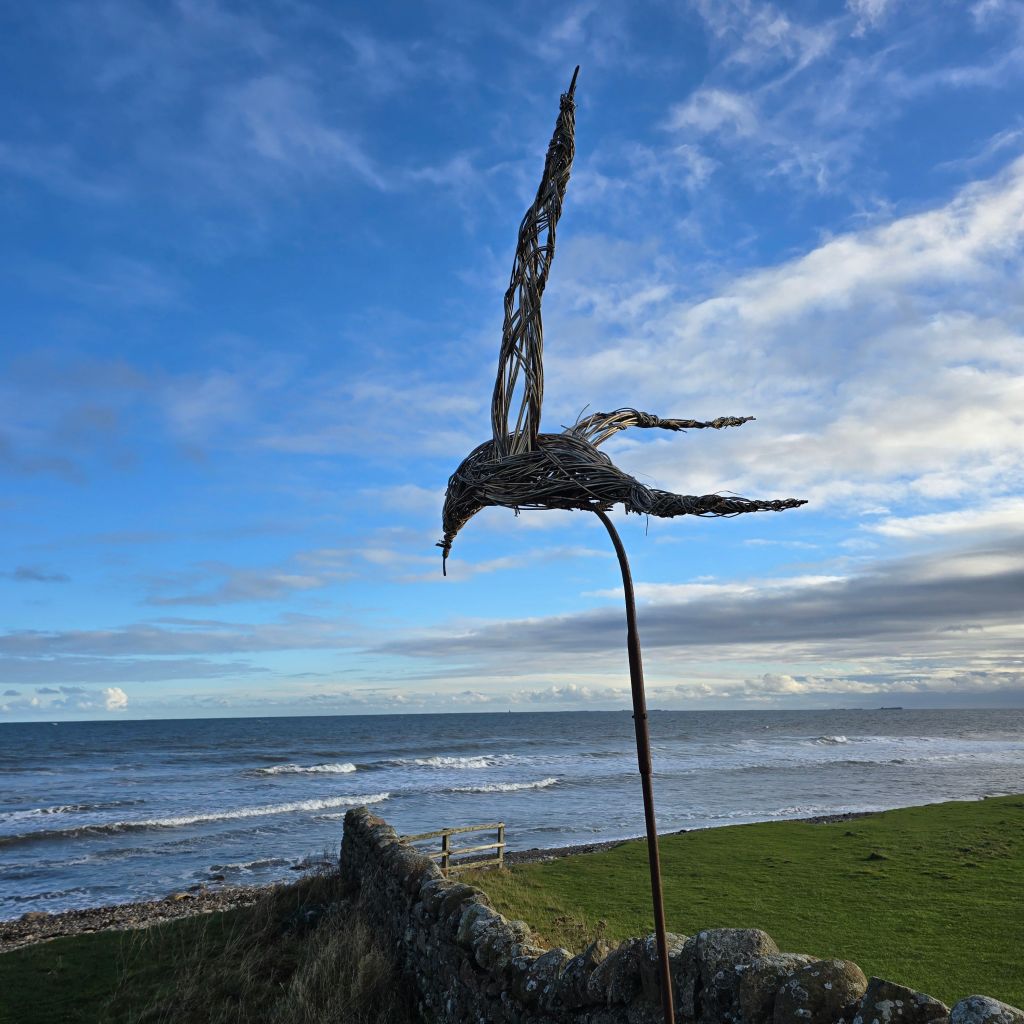
The Holy Spirit raised people’s eyes above their earthly nationhood to give them a fresh vision of society. (Sculpture on Holy Island, Northumbria – photo by Nick Morgan 2024)

Axios!

In which a new priestly colleague is welcomed…

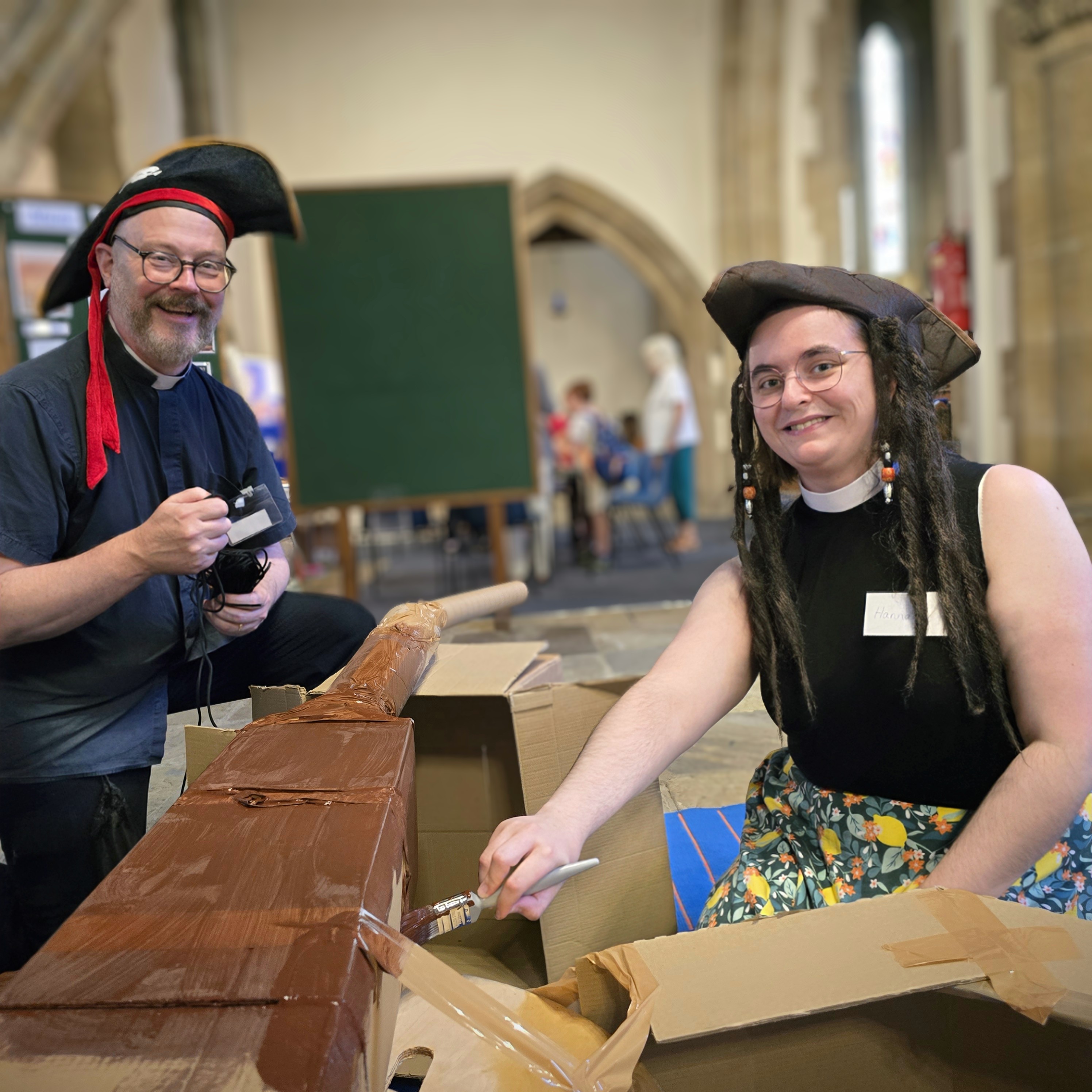
A sermon given on the Feast of St Peter and St Paul, Sunday 29th June 2025, the day after The Reverend Hannah Moore (my curate) was ordained to the priesthood at Selby Abbey.

The Feast of Peter and Paul is an ideal one on which to think about our vocation as Christians. Both these saints had a clear vocation: they were Apostles – messengers of the Gospel – and in that role anointed others to minister in the early church. Yesterday evening, many of us were in Selby Abbey as Bishop Flora continued that aspect of the Apostles’ ministry.  Early on in the life of the Church the role of Apostle developed into that of Bishop – an overseer of the Church, and one who lays hands on others as they are commissioned into ministry.  And so it came to pass yesterday that Bishop Flora laid hands upon Hannah, poured oil upon her head and anointed her for service as a priest in the Holy Catholic and Apostolic Church, beginning a new phase of Hannah’s ministry.

In the Orthodox Church, when someone is ordained priest, the Bishop and the people acclaim them by shouting the word “Axios!” three times.  This means “Worthy!”.  The Bishop and the people thus proclaim that this person is worthy to be a priest, worthy of their new ministry, worthy to administer the Sacraments, and acclamation by the people is a key part of the commissioning of a new priest because – and this is important – the ordination is of significance for the whole Church, not just for the new priest.

Yesterday’s service was a very special occasion for Hannah and those ordained alongside her, but it was special and important for the wider Church as well, especially churches such as ours where newly-minted priests are to minister. Nobody has a vocation in isolation. Just as Hannah is commissioned as a priest to serve among us, so we are commissioned to serve alongside her, partners in the Gospel, allowing her to grow in her priestly ministry, and as a leader, pastor, preacher, confessor, intercessor, teacher, and shepherd among us.  We are all of us called through our baptism to shine as a light in the world to the glory of God the Father. but that light is, and has ever been, a communal light. And part of a new priest’s role – Hannah’s role – is to help that communal light to shine.

St Paul: lone wolf?

Take St Paul as an example. Paul can sometimes come across as a superhero – a gifted and somewhat maverick leader who plants churches and has great adventures as he single-handedly spreads the Good News of Jesus all around the eastern Mediterranean.  But Paul is no lone wolf. When we delve into the Acts of the Apostles and Paul’s own letters, we learn that he has many travelling companions and collaborators in the Gospel without whom his ministry could not have happened. The list of his travelling companions includes names you may be familiar with such as Barnabas, Silas, Timothy, Mark and Luke, but there are others who only get a mention in passing – Epaphras, Gaius, Onesimus, Sosthines, Aristarchus, Jason, Sosipater, Trophimus, and Tychicus.  And then, add to this those who hosted Paul on his journeys and welcomed them into their homes. Add to this the leaders of the Christian communities he left behind or to whom he wrote letters: men like Philemon, Aquila, Erastus, Ananias and the splendidly-named Dionysius the Areopagite! And women like Junia, Phoebe, Priscilla, Damaris, and Lydia. And there will be countless more who are never namechecked in scripture who played their part in Paul’s ministry. 

It is sometimes said that it takes a village to raise a child. By the same token, it takes a church to raise a priest. We are the church communities where Hannah is being raised as a priest. And this is not only true of priests: it takes a church community to raise a disciple – each and every disciple.  God calls, disciples respond and follow, and the Church nurtures that spark of individual faith into a flame that grows, glows, warms, enlightens, and inspires the world with the Good News of Jesus. That is our communal calling with one another. That is what yesterday’s service means for us, Hannah’s church family, as we nurture the flame of her priestly ministry here, and as she in turn nurtures our discipleship. Our churches must be places where each of us can grow in faith, and our vocation as the people of God can grow and flourish.

One of our church schools, St Mary’s in Boston Spa, has been on something of a journey in recent years. It has developed rather wonderfully, and embedded in this success has been the renewal of the Christian vision of the school. My own experience is that St Mary’s school is a lovely place to visit, an excellent learning environment, and a wonderful community to be a part of as their vicar and as a governor. 

I mention this because of their school vision which I think our churches would do well to reflect upon and seek to emulate.  The vision is this: Together we inspire and nurture so that everyone can flourish. That statement, rooted in the vision of the Mustard Tree which Jesus spoke of as a model of the Kingdom of Heaven, is also a vision of what the Church should aspire to.  It represents a place where, from the tiniest seed of the Gospel, a mighty tree grows, a tree in whose branches all the birds of the air can find a safe place to be nurtured and flourish. It is a vision of inclusion, of safety, and of being surrounded by the truth of the Gospel: the truth that God is not distant, but is with us, all around us as our dwelling place here on earth, right now.  You see, our aspiration as followers of Jesus is not that we might go to heaven when we die. A mustard tree’s roots are in the soil of the earth, not the clouds above. And so our aspiration is that we continue the ministry of Jesus here on earth, that our faith is nurtured into the living reality of living like Jesus so that things on earth might be as it is in heaven. 

Together we can live out this truth in our church communities. We can be inspired by seeing Hannah’s calling blossoming into the living reality of her priestly ministry among us. We can be inspired by seeing St Mary’s School grow into a place where a vision rooted in the love of God inspires the flourishing of the whole school community. And we can live out these four truths:

  • that God the Father is not distant in heaven but lives on earth among his people, a loving Father among his family
  • that God the Son is alive and still active here on earth, bringing justice, healing, hope and love through his Church
  • that we are a loving community in whom God the Holy Spirit dwells; believers who live out the Gospel together, inspired to extraordinary acts of love, welcome, grace and generosity
  • and that we are people whose resources are at God’s disposal, whose time and gifts are used to God’s glory, and whose money is given generously to the ministry of his Church.

A priest stands among the people as a living reminder of God’s grace.  As Bishop Flora told us yesterday, a priest is a living Sacrament. By inhabiting the ministry of priest, Hannah is called to be a sign of God among us, a living Gospel flame – a beacon of God’s goodness and grace to all humanity. But every one of you is a living Gospel flame as well: called to be an embodiment of God’s goodness, and of the Good News of Jesus.  We are called, communally, as God’s family, to be God’s blessing in the world, called to pray for the world, to seek God’s will, to live out God’s justice, peace, grace, hope and love as church communities together.

You may not feel worthy of that calling today. Perhaps you think all this is for the holier folk, those more able to articulate their faith, the ones who have more obvious gifts, more visible gifts to offer in God’s service. People like Hannah. She does an excellent job of modelling her calling as a disciple of Christ, and now also as a priest in God’s Church. But the Good News is, that just as Hannah is worthy of her calling, you are worthy of yours as a child of God and as a follower of Jesus. That word again: Worthy! Axios!

So let us celebrate the fact that God has called Hannah to the life and work of a priest among us, just as God called Peter and Paul as his Apostles, and just as God calls each of us as disciples. Hannah, please stand at the top of the steps where we can all see you and acclaim you as worthy of your calling as priest. In fact, everyone please stand.

Hannah, we welcome you to priesthood in God’s Church here in these parishes.  We, your church family acclaim you as a priest among us. We will serve the Lord alongside you here. We find you worthy, indeed. I therefore invite the people of God gathered here to echo this threefold acclamation after me.

Axios! Axios! Axios!

And the people said?  AXIOS! AXIOS! AXIOS!

May we all be worthy followers of Christ  Amen.