Auschwitz is a place synonymous with evil and the worst of humanity. Rightly it is a focus of reminding us of the evils of antisemitism, as well as the Nazi persecution of Roma and Sinti people, political dissenters and LGBT+ folk. Dehumanisation of people in this camp of death was key to how the whole system worked. For most of the population of Germany during WW2, Auschwitz-Birkenau and other camps were out of sight, out of mind. What mattered under Nazi culture was the removal from society of people who didn’t fit within a narrow vision of who belonged in the 1000 Year Reich. Those who did not belong were cast as less than human, a pestilence to be eradicated. Industrial, systematic factories of death, such as Auschwitz-Birkenau were the result.
I am a Gen X Brit who grew up only a scant few decades after WW2, and Auschwitz and its horrors were certainly part of the tale of recent history which I grew up with. As a student of German O and A levels, it certainly came up through class discussions around some of the literature we studied, and the focus was very much on the Jewish holocaust. That aspect remains ingrained in me, alongside a strong instinct towards antisemitism, though I have become more aware of the wider picture of genocides and the many other ways humans dehumanize and oppress other humans in the years since.
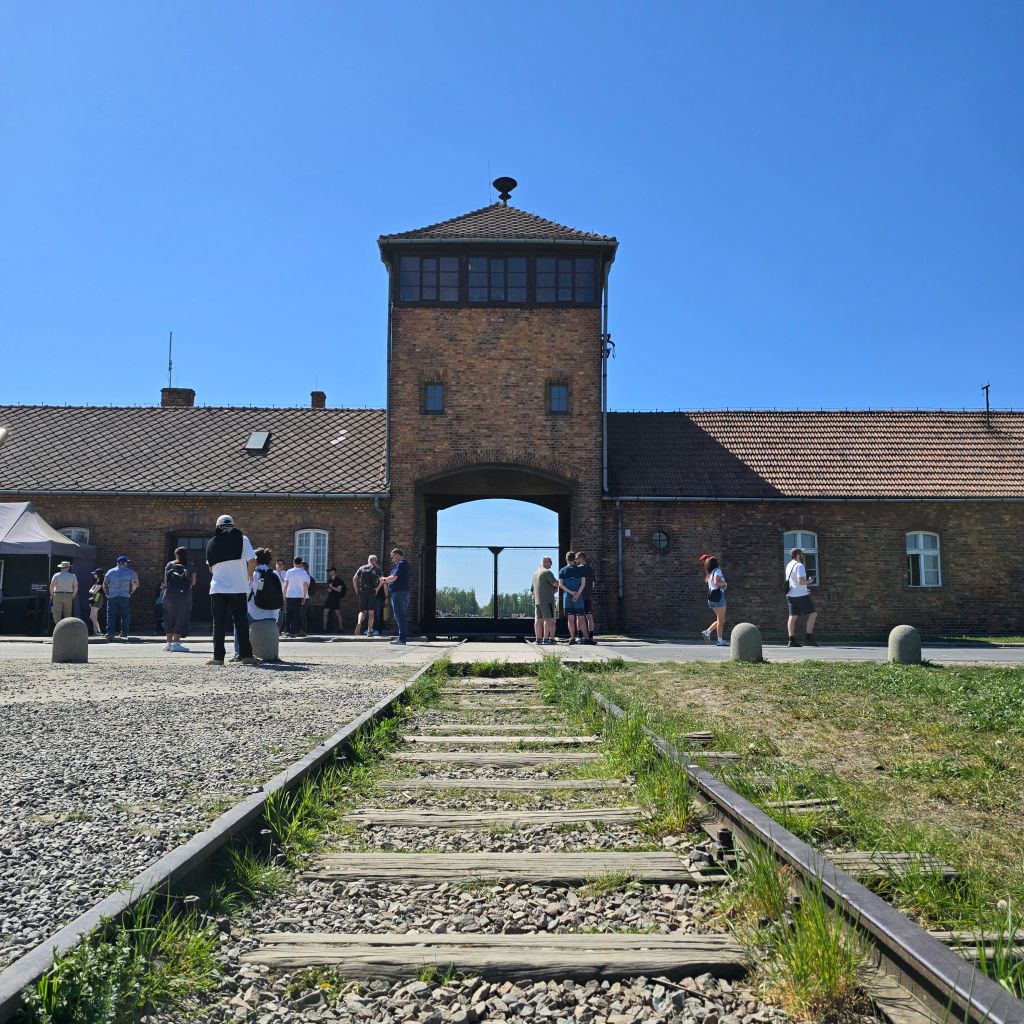
Photo credit: Nick Morgan, 3rd May 2026
So having just visited the site for the first time, one aspect struck me: the huts at Auschwitz-Birkenau had steps. This probably sounds insignificant amid many, more obvious, horrors there. But yes: those steps were what stayed with me, because nobody with a disability or even the slightest sniff of physical impairment even made it as far as those huts.
As soon as anyone disabled got off the train, they were sent, not to the huts in the labour camp, but to the gas chambers and crematorium. Among the disabled arriving on the trains were veterans of the Great War, those who lost limbs or were left with life-changing injuries. Despite their service in the armed forces of their nation, they had no place in the vision of the new, Nazi nation. They were murdered alongside all the others who were ‘less than’. In the museum there is a room full of prosthetic limbs, back supports, walking aids, trusses, adapted footwear and other assistive items stripped from disabled arrivals before their murder. It is a huge pile of items, and even this represents only a fraction of the horror: these items were merely what was found onsite at the end of the war.
The process of dehumanization was not extended to embrace disabled people: it was there right from the start of the Nazi project, way before Auschwitz was built, and indeed the denigration of disabled people is often one of the early indicators of a society going down a dark, evil and oppressive path. This was certainly the case with the Nazis. From the early 1930s, the regime frequently described disabled people as “useless eaters”, framing them as a drain on the taxes of non-disabled people in a time of economic strain. Depressingly similar attitudes and language is used in the UK these days around the issue of social security for disabled people, where further punitive restrictions and demeaning and exhausting processes are often announced by governments keen to reassure the able-bodied that their taxes are not being wasted on less economically-viable people. This is framed as preventing fraud, but the outcome is a culture in which all disabled people are made to feel they constantly have to justify themselves and prove they are deserving of even the slightest accommodation or adjustment which enables their participation in society.
The Nazis took this much further and much more quickly, but that is not to say it could not happen here. Having used a national poster campaign in the early 1930s to encourage people only to have children who were likely to be good, healthy stock (framing it as a patriotic duty to avoid having children if there were any hereditary conditions in either bloodline), the Nazis brought forward a ‘Law for the Prevention of Offspring with Hereditary Diseases’, which made the sterilisation of disabled people compulsory. This was met with depressingly little opposition when it was enacted in 1933 as the cultural dehumanisation had softened society up very effectively. The evil of the Jewish holocaust at industrial levels only fully came into effect at Auschwitz-Birkenau around a decade later, but the evil mindset which made this genocide possible began with the attack on disabled people as the cheapest and easiest win.
Vigilance is needed in our own age about any attempts to diminish, marginalize and dehumanize any groups of people on any grounds, whether race, gender, religion, sexuality, appearance, ability, impairment, capability, intellectual beliefs or disability. Disability is part of the diversity of human life and always has been. We need not look to paralympians or idealized, sentimentalized or heroic disabled individuals to justify the place of disabled people in our society. We are each of us capable of becoming disabled ourselves in an instant, as the result of an accident, or as our bodies unexpectedly turn on us with hidden conditions, or even just as a side effect of getting older. A core belief of Christians is that we are all made in the image of God, and that everyone is precious in God’s sight. Disability is not an aberration which excludes us from the Divine, or diminishes our worth or worthiness. When Jesus ascended into heaven, his resurrected body still bore the disabling wounds of the cross: his pierced hands, feet and side; the marks of the flogging and crown of thorns. It is not only the physically unwounded and unimpaired who are welcome to follow Christ into the perfection and glory of heaven.
Christians need to get ahead of this slippery slope by reframing our theology around disability (which needs a whole, separate blog post with links to disabled theologians!) and auditing not only our church buildings for accessibility, but the way we organise our services, events, communications and procedures. One of my churches undertook an accessibility audit and discovered (simply by asking people about things which made it harder for them to participate in services and the wider life of the church) how much we were unwittingly excluding people and preventing them flourishing. By addressing these barriers, we began to embed a theology of the equal value and vocation of everyone. But this was only a first step. We needed to change our mindset on inclusion, so that people with a lived experience of disability were around the table as leaders, not just as consultees, reflecting our equality as children of God and challenging our assumptions about calling and vocation.
We also need to amplify the voices of disabled theologians and actively listen to disabled Christians, trusting them to shape our understanding and inform our actions and activism in the fields of inclusion and disability rights.
The alternative to getting our collective acts together is an unequal vision of human worth, a blasphemy against the image of God within each of us. That easily becomes a vision which leads to our complicity in darkening political paths: roads and tracks which can end with the mundane yet evil reality of steps into huts.

 Vicar of Villages