
On earth as it is in heaven?

Pentecost 2026

On the day of Pentecost, something extraordinary happened. The Holy Spirit fell on a room full of frightened, uncertain people, and suddenly they found themselves speaking in languages they had never learned. And the crowds outside were astonished, not because everyone was saying the same thing in the same way, but because each person heard the good news in their own language, the voice and cadence of home.

The Holy Spirit honoured every language, every people, every place of origin. Parthians and Medes, people from Mesopotamia and Cappadocia, visitors from Rome and from North Africa, all hearing the same message, each voiced in a way which was familiar to them. Difference and diversity was not the problem. Diversity was inherent in how the Spirit chose to speak.

So this is where the Church begins: not with uniformity, but with a Spirit-filled community that holds together people of every nation and background.  And then, watch what happens next: as the weeks and months unfold in the early chapters of Acts, we see what that Pentecost community becomes in practice.  St Luke gives us two pictures of this, in chapters two and four of Acts.  All the believers were together and held everything in common. They sold property and possessions to give to anyone who had need. They broke bread in each other’s homes and ate together with glad and sincere hearts. There were no needy people among them, because those who owned land or houses sold them and brought the proceeds to the apostles, to be distributed to anyone who had need.

This is a community defined by how it loves and shares, not by who it excludes.  It crossed every social boundary of the ancient world. Wealthy landowners and day labourers; Jewish believers and Greek converts; men and women; the respectable and the marginalised, all held together by a common life rooted in the love of Christ.  And everyone notices!  Luke tells us they enjoyed the favour of all the people.  There was something visible, something distinctive about this community: you could see, from the outside, that something different was going on here. People were being cared for and nobody was being left behind.  The vulnerable, the widow, the orphan, the stranger, they all had a place at the table.  This is what the Holy Spirit produces.  Not just a warm feeling when they gather in worship or prayer, but a whole new way of living together.

Now, I want to make a connection that might surprise you, and I want to make it carefully lest I be misunderstood.  It involves a loaded and often divisive word: nationalism.  The Christian community we see emerging from Pentecost in the Book of Acts is a picture of what human society, at its best, is meant to look like.  And when we talk about nations, about what a nation is for and what holds it together and defines it, the Acts vision has something urgent and important to say in answer to the growing tide of nationalism around the world, including in our own country.

We have watched versions of nationalism grow, versions that are built on fear, on grievance, on the idea that our nation can only thrive if we define ourselves against someone else, the immigrant, the outsider, the other.  We have seen nationalism weaponised by politicians and influencers who wrap themselves in religious imagery while pursuing agendas of exclusion and division.  That version of nationalism is rightly challenged by followers of Christ as it is entirely at odds with the ministry of Jesus and the Holy Spirit-inspired Pentecost community of inclusion, empowerment and love which we celebrate today.

But this is not the only vision of nationhood and nationalism available.  If by nationalism we mean a way of defining what makes us cohesive as a nation, what our shared values and vision are, what both the breadth and the limits of our sense of nationhood are, Christians have, in the post-Pentecost community of believers, a wonderful model to draw upon.  And we, the Church, as people inspired by that same Spirit, absolutely must stand up for that vision in times like these.

Earlier this year, the former Bishop of Leeds, Nick Baines, published a substantial and thoughtful report called Reimagining Europe.  It is a serious piece of work, and I commend it to you.  In it, Bishop Nick makes a careful argument that nationalism, properly understood, is not inherently destructive. He points out that civic nationalism, a shared sense of belonging rooted in common values, mutual obligation, and the rule of law, has provided the foundation for democracy, for the welfare state, for public education, for all the institutions that exist to serve the common good rather than the powerful few. This is a nationalism which gives a sense of belonging, interdependence and shared values; a national identity which makes for a stable, safe society in which all may flourish within a clear legal and constitutional framework.  The problem, he argues, is not nationalism itself, but the ethnic, exclusionary version of nationalism which hijacks the language of national identity for its own narrow purposes.

Bishop Nick goes further.  He says that Christians are particularly well placed to offer a different vision because the Church, at its best, is already a community that holds together people of every background in a common life shaped by shared values.  Church communities practise, however imperfectly, what a genuinely inclusive community looks like.  And we have something transformative to say about how nations could similarly thrive if we draw upon the vision of the early Church in Acts as a model of communal living and interdependence.

That argument feels urgent right now. We are living in a time when the settlement that has kept Europe largely at peace for eighty years is under serious strain. The war in Ukraine is not just a distant tragedy. It is a stark reminder of what happens when one nation decides that another has no right to exist, no right to its own identity, its own language, its own place in the world. Thousands of people are dying because a neighbouring power refuses to honour the particular dignity of a particular nation. And across Europe more broadly, we are watching the slow erosion of the values that have underpinned our common life since 1945. The rule of law, the rights of minorities, the independence of courts and press, the right to trial by jury, the willingness to pool some sovereignty for the common good of all, the concept that telling the truth in public life matters.  These things are being quietly dismantled in some places, and loudly trashed in others, with no commitment to finding positive new structures, safeguards and shared moral vision to take the place of that hard-won scaffolding which sought peace, stability, mutual respect and flourishing.

This is the moment for Christians to speak, not with anger or with partisan political noise, but with the clear and grounded voice of people who know, from their own Scriptures and their own communal life, what genuine mutual flourishing looks like.

A nationalism worth the name is not about who we keep out. It is about what we hold in common. It is about the kind of society we are building together: whether the vulnerable are cared for, whether the stranger is welcomed, whether the rule of law applies equally to everyone, whether truth matters, whether the next generation inherits something worth having, whether our shared planet, its natural environment, climate and resources remain sustainable and liveable.

That is the Acts vision, scaled up. God’s people are called to be a holy nation, a model of what an earthly nation might also strive to become: a community of people, rooted in a particular place, shaped by particular values, committed to the common good of all who live among them. Not because they are all the same, but because they are all held within the same generous, costly, inclusive love. We know this as the love of Jesus. And we should seek to spread that love, not by conquest, but by being the pervasive and irresistible aroma of Christ in the world. We should love as lavishly as those first-generation Christians did so that everyone notices how we love one another, and how we model holy nationhood in our church communities. The fragrance of Jesus must fill the world around us as we live his risen life together in the power of the Holy Spirit.

Pentecost did not erase the nationhood of all those diverse people. The Holy Spirit redeemed their nationhood by revealing a new way of living communally. They received the Gospel in their own tongue and the Holy Spirit revealed to them what belonging to a people could look like when it is animated by something larger than fear or pride or grievance.

That is the vision we are called to embody in the common life of our church community, and in the way we speak into the public conversation of our times. May the Holy Spirit fall upon us, and equip us with the courage, and the clarity, to do so. Amen.
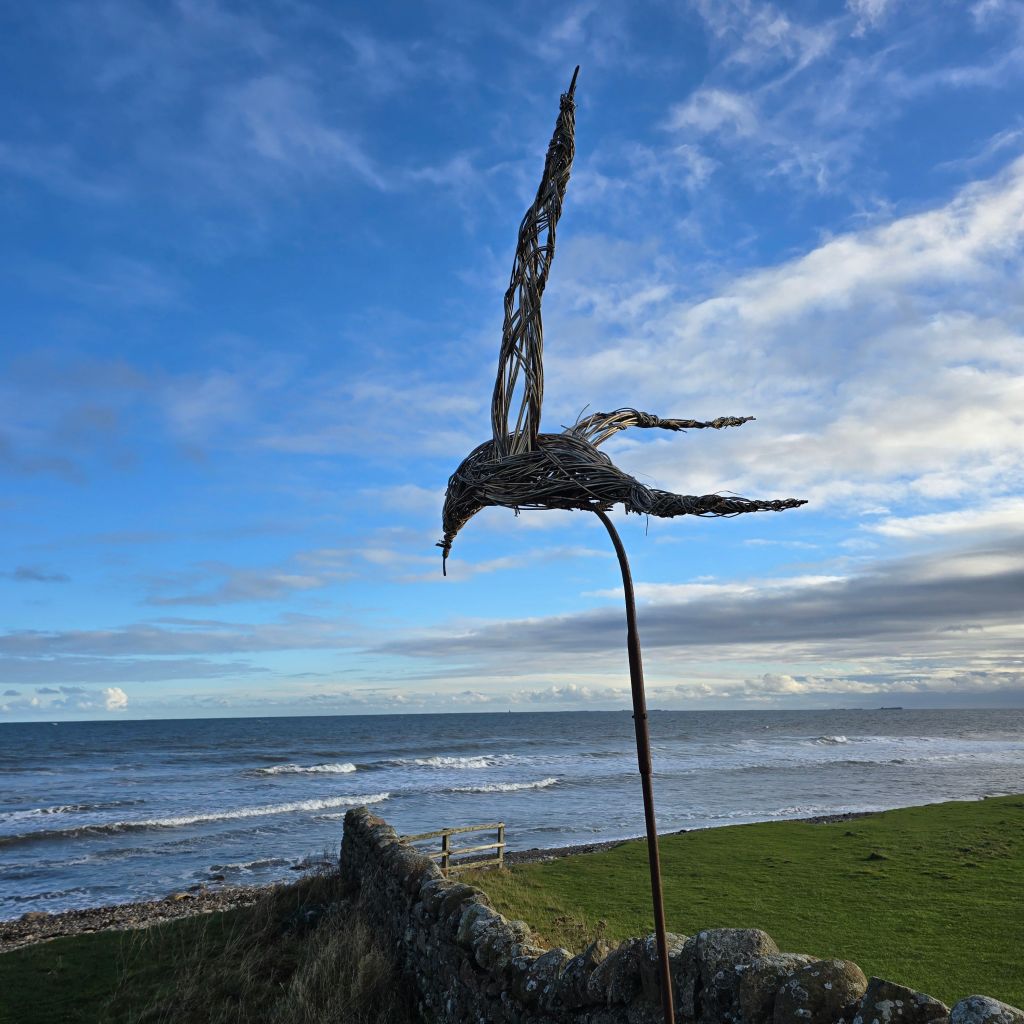
The Holy Spirit raised people’s eyes above their earthly nationhood to give them a fresh vision of society. (Sculpture on Holy Island, Northumbria – photo by Nick Morgan 2024)

A vision revisited

On holiday around Easter 2012, I was in Scarborough and had a vision. Here it is again, but with a few thoughts about how this seems to me 9 years later, and especially as we consider how church communities and networks might appear in the light of Covid19.

An immense shape appears – so huge you cannot see all of it – rising up from the landscape, looming over the landscape but not coming out of it as such, more a distinct presence among the panorama of the South Bay of Scarborough, including the Spa Conference centre and Grand Hotel. Its shape is indescribable: very beautiful and with many surfaces, colours, textures and materials. Some parts are jewelled, some are rough, some glass and see-through, some shiny, some opaque, and all of this is visible in incredible detail, far beyond what I could have really made out with the naked eye had I been seeing it in the flesh. It is astonishingly beautiful and I cannot for the life of me say why as it is almost formless, shapeless, artless in its construction, impossible to say which way is up, where it begins or ends. It is architecturally incoherent. It is absolutely, indescribably huge.

I say to myself, “Is this a good thing or a distraction? Is it from God or not?” And I hear the answer as another question: “What would a child think?”

A child would see it is beautiful too. It’s attractive, there is lots to get involved with, many ways of seeing it but almost impossible to see all at once. The outside is what we see, in all its weird variety and, as I look closely I see that there are pathways, handrails, tracks leading in from every surface, every part of it, continuing around the structure and leading further into it.

Accept it as a child, then. All the surfaces have a way into the centre, into the heart of it. All the surfaces are a way in, potentially. I muse that you could still admire or decry this thing from the outside without actually exploring it or engaging with it.

I look at it with my youngest daughter. She is drawn to different faces of it to those I noticed most. She sees coloured, see-through, glass-like flowers with layers of other shapes in different colours nestled behind. I had seen grander, more stained-glass-like structures at first. The whole thing is historic and huge, ancient, but very new; very old indeed and changing; moving all the time, never still; always in the “now”. On looking again, I see parts which don’t attract me at all: dull surfaces, odd angles and shapes which say nothing to me at all. They all lead into the same structure though.

And the image faded and the seagulls began their racket. And I knew I had seen a vision of the Universal Church throughout all ages and was shaking in wonder. I needed to think, reflect and pray on this.

The next morning, I prayed through this vision. The sheer variety of the appearance of the Church was wonderful. Just imagine the sheer variety of expressions of what it means to be Church in ages past through to the present and in cultures worldwide! Many of these expressions of Church will be unattractive to us. Some will be, frankly, incomprehensible. That’s all good. We are whom we are, here and now. That is true for God’s people throughout history, and our Church will not look like theirs and will not even look like that of all our contemporaries, either. Whenever we think of equipping ourselves and our churches for ministry and mission, we can lose sight of the fact that the Holy Spirit, on whom we rely for that equipping, is a wild goose that blows where it will and, as this vision reminds us, shapes the Church in more ways than we can possibly imagine.

You only have to read Paul’s epistles to see how varied even the early church was: the sheer variety of the issues Paul deals with pastorally in these letters, and the variety of focus in his teaching in order to equip each Christian community for its life and ministry together, tells us that they were not identical in character. God meets people where they are, not where we think they ought to be. The Church has to reflect that reality.

So, as we listen for God’s voice, pray for equipping and invite the Holy Spirit to work in us and our churches, we do so in humility, knowing that we are not creating a blueprint for every church. We are called to shape our facet of the Church into something beautiful, but something which is part of a far more awesome whole.

and so, to the future…

2021 coda:

We have been forced by circumstances to explore new ways to worship and to express what it means to follow Jesus lately. With varying degrees of agility, and in many different ways, church communities came to very different solutions when faced with the lockdown conundrum: how to love and serve God and neighbour, and how to enflesh Jesus in the world at a time when to meet in the flesh was unwise and not even possible in most circumstances. It looks at the time of writing (May 2021) as though we dare hope that a renewal of in-the-flesh fellowship and worship can be resumed, though we cannot take for granted that pandemics and infection control are all in the past. We have seen the Church expressed from different angles to those we were used to, but where the Holy Spirit has been at work, all these visible glimpses of a varied Church always lead into the centre – into the life of God, into Jesus, into God’s kingdom.

So what now? My hope in Church of England terms is that new networks and structures emerge. The difficulties of governance and operating the old networks of deanery, archdeaconry and diocese during lockdown in many cases proved a blessing, in that the time and energy released from top-down models of teambuilding, vision-building and measuring of ministry were redeployed into a more natural, less formal form of mutual support, and into “just getting on with it as best we can, as the Spirit leads”. Networks sort of “just happened”; materials, ideas and support were generously flung around to be experimented with by each other, long before the national church was even out of the starting blocks with resources and support. We became agile.

It is tempting for any organisation as large and cumbersome as the Church of England to attempt to “build back better” through top down initiatives and vision building. Yes, it’s laudable to make sure nobody remains unsupported, to ensure there is some sense of shared purpose, but the Holy Spirit’s “wild goose” needs space to honk, too. Because we are a hierarchical structure, we find it almost impossible to invert the pyramid and be informed by what the Holy Spirit is doing across the broad base of everyday life in Christ. We’ve heard much honking over the past year or so – by which I mean, God’ Church in communities all over the place, have not been silent or inactive, and the Holy Spirit has let loose Christ in the world. So what have we learned?

How about the following naive, unformed and shapeless picture, which is not dissimilar to the weirdness I saw in Scarborough 9 years ago? What are the keys to revealing new facets of the Church which we might glimpse, and which will attract others into the centre, to Jesus, to life in God?

Local church communities, loving and serving their communities. Let’s learn from rural churches and estate churches: what leads from what people see, into the centre – to Jesus – where you live? Alongside these, let’s learn from chaplaincies: what leads from what people see, into the centre – to Jesus – where you work or study?

Online and informal networks of folk in not-dissimilar situations. Yes, there are more formal expressions of this which are key parts of the picture (Mustard Seed, Multiply, the National Estate Church Network, rural church networks such as Germinate and so on) but the energy for all these has to come from the roots up – from the lived reality of what the Spirit is doing in people’s lives, and in God’s Church in their daily lives and communities.

Ways of equipping the Church which are agile. How about contracting out of much of ministry support and training away from diocesan staff? The current mindset seems to be that for each Important Thing We Do we employ people. Instead, each “unit of ministry” (the jury is still out on exactly what this term means) is given a budget to contract in advice and support appropriate to their culture, community and missional priorities. For me, a unit of ministry should be as small as possible, and the idea should be that the budget is not centrally-mandated but applied for where it cannot be covered locally, and wealthier units of ministry pay into the pot for others to draw upon. Units of ministry could combine budgets to share in advice where this makes sense on a project-by-project basis, but the idea generally is that, from the dazzling array of organisations out there who can offer this expertise, local church communities can receive support, resources and training, and as time goes on, people within these communities become able to train others, since our expectation should be the equipping of every Christian for discipleship. None of the above is to diss any diocesan officer (I have reason to be grateful to many of them!), but if we are questioning how we do ministry, that’s where I have got to in my strategic questioning: are we getting enough targeted bang for our buck in the way we currently do the equipping and supporting?

Our Structures and governance are antiquated, and the pace of change is far too slow. Roles such as churchwarden, treasurer and synod members have been hugely outpaced by cultural and sociological changes. The internet and mobile technology (magnified by homeworking practices under lockdown) have led to a culture of working long hours, well beyond the traditional nine to five. There is little time, energy or headspace left at the end of what the world of work, family life and any down-time leisure leaves over for many people of working age. It’s little better for those those in retirement: volunteering and other activities tend to be varied. It is unusual for a retired person’s time and energy to be confined to church, and indeed we don’t really want that, do we? We’re called to everyday discipleship, so being out there doing pilates, playing croquet, tending an allotment, playing in an orchestra, walking the dog with friends, being active in the community litter picking group, or green issues group, singing in a community choir, or playing bridge (to select some examples in my parishes) is what we want members of our congregation to be doing, and to be taking Jesus there with them, isn’t it? So there is a problem at the parish level with the demands and expectations inherent in certain roles. Yes, as part of our response to the same trends, we also need to be more effectively and urgently developing a culture of everyday discipleship, but many churches are onto that already – I’d like to hope very widely so. A more collegiate approach to fulfilling statutory and leadership duties is what is emerging naturally in many places. Perhaps this can be caught up with “officially”.

At a national level, the ponderings of Diocesan and General Synods are manifold, interesting and largely relevant to ministry, yet embed a sense of centralisation of thought and process. We need to be sure what needs national, co-ordinated thinking, and what needs to be left free for local discernment under episcopal oversight. Similarly, there is something to be said for pressing reset and nationally redrawing parish, deanery and diocesan boundaries, and making the edges much fuzzier (i.e. easier to co-operate across and to embrace an agile, networked approach). There is also the fact that this is currently legally impossible to implement, and for the time being, all that happens is that clergy moving on, retiring or dying are the only times which offer wriggle room, and this means that mere tinkering at the edges of structures is all that happens, seldom strategically or based on a missional imperative. I really do understand the ecclesiological problems with some of this as well (and yes, it would need General Synod’s manifold and careful pondering to achieve!) and have no desire to break with geographically-based episcopal oversight (as any other kind of pick-n-mix approach leads to schism and unholy power play). That being said, if our desire remains to be a Christian presence in every community, we need to recognize that “community” looks different to how it did when boundaries were created. Lives are lived differents and community is not only expressed geographically. A far more agile, networked approach is what the Holy Spirit has taught us through this Covid experience and needs space to be expressed in our governance and structures. It needs to be implemented in some way other than adding additional, networked layers over existing ways of doing things as we need to be working smarter, not more complex and time-consuming.

This may all sound simplistic, unworkable and naive – I have never sat on any Diocesan finance committee for good reason. I am, I hope, more useful on the praying, listening, discerning, vision and “cracking on with the job” side of things. But I am absolutely sure that agility alongside an ability to listen to the Holy Spirit will be key to growing in Christ in these times we live in. And the latter is where Diocesan structures really do come in: the spiritual leadership of our senior clergy. As a Priest in Charge, I am licensed to locally and vicariously express the apostolic ministry of my Bishops. Along with the Archdeacons, what I particularly need is their blessing, their teaching, and their spiritual leadership as my fathers and mothers in Christ. I’m not saying this is lacking: I’m simply stating how I see things joining up in terms of the big picture stuff. I want them to be freed up to express their apostolic calling by devolving much of their managerial responsibilities without us becoming a corporate monolith. This is tricky given the perils of this (i.e. to whom is what devolved, and how), and the legal complexity of running an organization of this size with such a huge hinterland of ecclesiastical law which is not easily understood, and is often overlooked, by lawmakers in Westminster). And I want for myself the humility to listen and be led by my Bishops as I ponder (together with the flocks entrusted to my care) how to do this kingdom of God stuff in the 2020s and beyond.

Conclusion

As I continue to pray and ponder, let’s return to the vision of 2012 and consider our ministries and the obstacles to it, external or self-inflicted, in the light of some words of Jesus. This is lest I start overthinking, or overestimating my own importance… (using the translation “The Bible for Everyone”)

At that time the disciples came to Jesus. “So then,” they said, “who is the greatest in the kingdom of heaven?” Jesus called a child and stood her in the middle of them. “I’m telling you the truth,” he said. “Unless you turn inside out and become like children, you will never, ever, get into the kingdom of heaven. So if any of you make yourselves humble like this child, you will be great in the kingdom of heaven. And if anyone welcomes one such child in my name, they welcome me. Whoever causes one of these little ones to believe in me to trip up,” he went on, “it would be better for them to have a huge millstone hung around their neck and be drowned far out in the deep sea. It is a terrible thing for the world that people will be made to stumble. Obstacles are bound to appear and trip people up, but it will be terrible for the person who makes them come.”

Matthew 18:1-7

From the vision of 2012: I say to myself, “Is this a good thing or a distraction? Is it from God or not?” And I hear the answer as another question: “What would a child think?”