
A visit to the cinema got me thinking…
Tag: jesus
Worried about encroaching darkness?
When I survey the wondrous cross
One of my favourite hymns is “When I survey the wondrous cross”, a poignant reflection on the love of Jesus which led him to the cross and which urges us to follow his example of wholehearted love for others. The cross was originally a symbol of oppression and injustice, an instrument of torture and state-sponsored execution by the Roman Empire. The events of Good Friday and Easter meant that this symbol was subverted. Because of Jesus, the cross now is a symbol of hope and love, and stands as the ultimate reminder of the generous heart of God who loved us so much that his Son, Jesus, spread his arms wide on the cross to embrace us all, inviting us to open our hearts to embrace and accept his love in return. The flag of St George, England’s national flag, reminds us of this: red for the blood of Christ, shed for the sake of God’s love for all humanity as he died on the cross, and white for the glory of heaven and eternal life which that shedding of blood revealed.
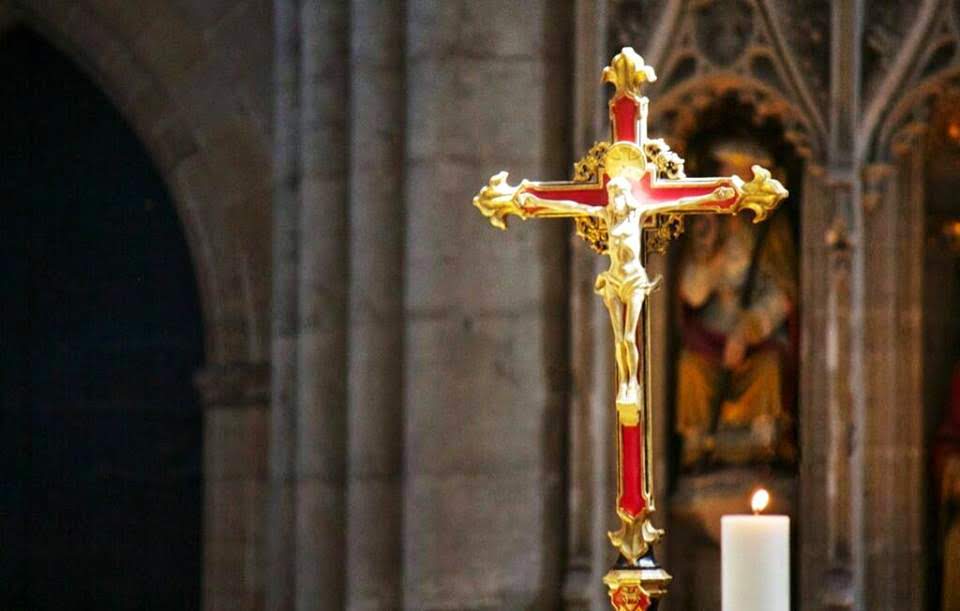
Which brings me to a more recent subversion of the cross as a symbol. Whatever the genuinely patriotic intentions of some of the individuals who participated in the recent flag flying campaign, the result (arguably the intention of those who devised the campaign) was to intimidate minority groups. Online comments, and those of commentators from the far-right of politics show only too well how this display of flags, far from being a patriotic celebration of our nation and national community, is being used as a tool of racism, the cross of Christ weaponised to incite division, and as a cover for outright nationalistic hatred of anyone outside a very narrow definition of Englishness.

Our national flags should be a source of pride – indeed, they are flown from our churches on occasions of national significance and paraded on Remembrance Sunday as symbols of national unity. I do not believe that the recent campaign serves this purpose. While some who promote the campaign say they only wish to promote patriotism through their actions, the reality is that the way in which our national flags, especially the flag of St George, are being used to vandalise monuments such as the White Horse of Kilburn, or roundabouts, or being flown (often half mast!) from lampposts, bridges and elsewhere does the very opposite of promoting national cohesion. The intention is to tell some people that they do not belong, that they are not welcome. The fact that the Cross of Christ is the key symbol of our national flags means that, as a Christian, their use matters to me. Any use of the Cross of Christ as a tool of oppression, exclusion, or of making people feel unwelcome is a blasphemy. It takes the meaning of the cross back to its Roman origins: to use it as a tool of fear and division, the very opposite of the Cross of Christ which stands, red on white on the flag of England. Yes, I am uncomfortably aware that the flag of St George was used by the Crusaders in medieval times, and that their actions did much to damage the mission of the Church through the atrocities which were committed in the name of Christ under the banner of this very same cross. And yes, that was endorsed by the Church at the time. So we must learn from past mistakes, repent, and not let the cross become synonymous with hate, division, violence, exclusion and injustice again. Turning from past mistakes is the very definition of repentance and is part of the Christian path of redemption which the Cross points us towards.
I am proud that, in our diverse nation, our flag bears the cross of Christ, a symbol of Christ’s love in the face of evil, and his defeat of sin and death. We will continue to proudly welcome our nation’s flags into our churches on Remembrance Sunday and fly them on national occasions as symbols of our Christian heritage as a nation, a heritage which should inspire us to acts of love, justice, peace, hope, welcome, forgiveness and inclusion. As you look at our flags, wherever they are flown or displayed, I hope these values are what you choose to see and be inspired by, because they are the values we should aspire to as a nation, values revealed through Christ and his cross.
Magnificat: a call to justice and peace
SERMON given at St Mary’s Church, Boston Spa on Sunday 22nd December 2024 – Advent 4
Trigger warning: includes references to the Gisèle Pelicot case and Safeguarding failures in the Church of England
Readings: Micah 5:2-5a and Luke 1:39-55
Few can fail to admire Gisèle Pelicot whose bravery in waiving her right to anonymity and speaking out publicly has not only brought her justice for herself, but has blown the secrecy surrounding a culture of abuse, the full scale of which is not yet apparent. What an amazing woman, to step into the public gaze in these circumstances and bring into the light, malevolent acts veiled in darkness. Her voice has been heard, and the world is the better for it.
There is in any society a problem of privileging some voices over others. It is a problem because those with power are heard most. Elon Musk uses his wealth to amplify the voices of the rich and powerful to political ends. The UK media is selective in which politicians it gives air time and column inches to, with a preference towards the forces of power, populism and wealth. Part of the problem with historic cases of abuse in the Church of England has been a lack of willingness to challenge those in positions of privilege who are used to always being heard and respected. Those we now know to be abusers who operated within the Church of England were invariably confident, charismatic, well-connected men who were listened to, and used to being listened to, often uncritically, whose reputations were prioritized, and whose ministries were underpinned by a warped theology which reinforces inequality, exclusion and privilege. The voices of their victims were for too many years not heard, and the structures of the Church of England, historically, have worked against transparency and justice. Not all voices are equal in this world, and the Church of England must urgently get better at hearing the voices of victims of abuse, and the prophetic voices of those who are too often overlooked. This is not simply a trendy, contemporary matter: the Bible is littered with unlikely voices – voices of the powerless, the overlooked, the unlikely and the marginal through whom God spoke with great power. Abraham and Sarah, the unlikely elderly first time parents. Jacob the liar. Moses the stutterer. Ruth the Moabite woman. David the shepherd boy. Unlikely folk who were all key parts of the tale which leads to the birth of Jesus. And indeed that is how the message of the birth of Jesus came to us: unlikely voices of great significance.
Our Gospel reading centres on two amazing women: Elizabeth and Mary, each of whom is faced with life in a mess. Elizabeth has been childless but has unexpectedly become pregnant at a time of life when she thought this was impossible. Added to that, her husband is suddenly rendered mute, unable to speak. At the arrival of her relative, Mary, the baby within her leaps for joy and she is filled with the Holy Spirit. The whole situation is Inconvenient, Messy, and Weird. Then there’s Mary, who was visited by an angel – a hugely disruptive event in which she was told amazing news that she is to bear God’s Son and who reacted by saying “Yes” to God. Her life is turned upside down, and here she is visiting her relative, Elizabeth. These women’s lives are in a state of mess. Things are not as they imagined, this is not the life they had planned, but they each have a sense that they are part of something bigger than themselves.
So if anyone ever tells you that politics and religion should never be mixed, just point them to Mary’s words. We sing or say them in church as the Magnificat, regularly as part of Evensong and their familiarity can, I think, lead us to ignore how radical these words truly are. This young woman, faced with her life being turned upside down, faced with a pregnancy which is potentially socially shameful, faced with the astonishing weirdness of an angelic message that she is to be the God-bearer, she responds by rejoicing in God her Saviour. She acknowledges her lowliness before the holiness and mightiness of God; she exults in the way in which God promises to turn the power dynamics of the world upside down, to mess up the grand plans of humanity, to cast down the mighty, to exalt the humble and meek, to feed the hungry and leave the rich to their own devices, and in this Mary sees through the mess of her own circumstances to God fulfilling the promise to Abraham and the people of Israel through her and through the chaos of her life.
Christmas can be a disruptive time, a time of mess. Perhaps it’s a time of inconvenient journeys to see loved ones. A time of making up spare rooms and preparing for grandchildren to scatter paper and toys around your house. Maybe it’s a time of remembering loved ones who are no longer here to be with us around the table for Christmas dinner. For some, it’s a time of feeling pressure to spend more than we should, to do things we really have no energy for. Or a time of being rejected by members of your own family, perhaps. It can be messy. But the mess of our lives is what Jesus came to get involved in. The love of God was not revealed by an authoritative voice of privilege: not through a charismatic religious leader used to being heard unchallenged. Not a priest, prophet or king. The love of God was enfleshed among us through an unregarded, young woman who said “Yes” to God; who spoke prophetically to an audience of just a single, similarly unimportant, overlooked woman in words which resonate today; whose words welcoming God’s justice and peace we do well to echo.
The Church of England has to be ready to listen and respond to those who bravely step up to bring dark matters to light. We owe them the justice and peace of Christ in the way we respond to the abuse they endured. This is a matter of behaving prophetically and saying “Yes” to the justice of God which Mary said yes to, inconvenient and uncomfortable as it was for her to do so.
And you and me, as we prepare for Christmas, we need to ask whether we are ready to hear the voice of God in unexpected places. Are we ready to listen to the voices of the overlooked, the unimportant and expect to encounter the love of God through them? Are we ready to invite God into our hearts afresh, into lives which are not perfect, and parts of which are doubtless still messy? Like Mary, let us be ready to rejoice when God shakes our lives up. Let’s be ready to say yes to God, as Mary did, and to be bearers of Christ ourselves as we take the light of Christ into the mess of the world. Like Mary and Elizabeth, we are called to be prophets who welcome and rejoice in the justice and peace of God. May it be so. Amen.
From impairment to flourishing
The radical inclusion of the Gospel.
SERMON for the 5th Sunday of Lent, 2024. Readings are Jeremiah 31.31–34 and John 12.20–33

A seed looks dead, but we know that if it is planted in the earth we can expect to see it spring to life in due course. Jesus is telling us in that metaphor what will happen to him: he will be dead and buried, then rise again. But he also tells us that, as a result of that new life, other grains will grow and multiply. It is no small thing: the death of Jesus is not merely the death of one man, it is the taking on of evil: the saving of the whole world, putting sin itself to death, burying it, so that resurrection life may come in its place.
Greeks appear saying, “We want to see Jesus.” They have come to worship at the Jewish festival as Roman citizens. They are drawn to Judaism, rejecting the pick-and-mix Roman gods, and the spirit of their age. These Greeks did their best to follow the Law and Jewish customs, but they could not participate in temple worship or all the ritual requirements of the Jewish faith. They were Gentiles, outsiders, so there were very real, human barriers to their inclusion in worship and the communal life of God’s people. They were not part of the Covenant between God and Israel.
But long before this scene, Jeremiah wrote of the limitations of this covenant. One side of the deal was to be a holy nation, called to be the light of the world. But the human heart falls short: they did not live as a holy nation. So Jeremiah is given a new message: God will enter into a new covenant, a new promise, written on the heart, a covenant which goes beyond the letter of the Law. Today’s Gospel reveals how inclusive this new covenant, our covenant, really is.
The Greeks asking to see Jesus is a sign: the Holy Spirit is moving in hearts and minds, causing people to reject the spirit of the age, to yearn for change; their hearts are seeking God. This is a dramatic moment: Jesus’ response to the world knocking at his door is to set his face towards the cross and to call us to follow in his footsteps, and this will be to the glory of God. The grain of wheat will be dead and buried, then rise again and bear fruit.
The radical inclusion of the Gospel is plain to see: Jesus died for the sins of the whole world. He performed miracles not just among the righteous and respectable but with outsiders: Gentiles, disabled people, soldiers of an occupying army, folk on the fringes of society. And each of these were drawn to Jesus, and went on their way praising God, and knowing who Jesus is.
Jesus tells his disciples that he will die on the cross to draw all people to himself. It is a calling to all humanity to repent, to have God’s law inscribed upon our hearts so we live in righteousness. It is a calling to turn the world upside down, to trample down the barriers of humanity and come together as disciples of Christ. Going back to our Prayer Candle – that is why the inclusion of people with impairments in our church and our society matters: it is a Gospel imperative, not an optional add on. This is why we pray today for tomorrow’s hearing at the UN when the UK government will answer to the international community for its violation of the 2009 Convention on the Rights of Disabled Persons.
Impairment vs. Disability

Just to unpick language a moment: there is a difference between someone being impaired and someone being disabled. When the impaired do not have their impairment taken seriously and reasonable adjustments made so they can participate, that is the point at which they become disabled. Their impairment is something we cannot readily change. The word “disability” on the other hand means the lack of ability (dis-ability) to participate, so that is something we very often can do something about, and we must do something about it communally, both in church and in our society. Jesus rose to “new life – life in all its fulness”, so our goal should be human flourishing: participation together. Our church school, St Mary’s, has an excellent vision statement which draws deeply on this Gospel theme: “Together, we inspire and nurture so that everyone can flourish”. A great motto for a school, but it also sums up what it means to be the Church of God in this and every generation. We should aspire to be a place of welcome to everyone, so that all the modern equivalents of the Greeks who came to seek Jesus can seek him here, whatever their gender, race, impairment, disability, sexuality or socio-economic background. Like Jeremiah, our calling is to be prophets in our own generation: to cry out for justice for everyone, which tomorrow especially means justice for Deaf and Disabled people in the UK – to pray, and make a fuss to our elected representatives about it. To proclaim to everyone that they are loved by God, loved by us, and are precious in God’s sight and ours. This radical inclusion is not an optional extra to our faith. The love of God is everlasting and infinite. We are called to inherit what Jeremiah promised: to know God, and to have everything which keeps us from godly living forgotten – barriers to our flourishing struck from history.
God’s vision of inclusion
We are called to share that promise with our world, and to have God’s generous vision of inclusion, so that we preach the full Gospel of repentance and forgiveness of sins, of receiving God’s wholeness and healing, and of being transformed into God’s Holy people to stand against the divisive, unloving, mean-minded, unjust spirit of our age.
Our Diocesan vision, Living Christ’s Story has asked us to address how we reach people we currently don’t. It is an inclusive vision which we must grasp as a church community. I want people to know that they can encounter the love of God here, that they can meet Jesus here, that here is a safe space to turn to Christ and be transformed into the likeness of Christ. But we need to make sure we know that they are welcome, regardless of their age, gender, race, socio-economic background, sexuality, or disability.

May that Covenant, the Law of the Love of God revealed in Christ Jesus, which tramples human barriers and limitations into dust, be written on our hearts, and may we all be prophets of this inclusive covenant of grace in our world, to the glory of God. Amen.
Micah, the BBC and me

Broadcasting House
Back in the day, I worked at BBC Broadcasting House on a few occasions (recording radio shows for RTE Ireland). I once smiled at John Peel in the lobby there, and witnessed John Humphrys dashing out of the building, but this was as near to celeb stalking that I could manage. There was a buzz about the place and a sense of weight to what went on there. This was before the building had its revamp, so it still held that mid-20th century feel of being at the heart of national conversation, its 1920s architecture a reminder of aspirations after The Great War: “Nation shall speak peace unto nation”, was inscribed above the entrance (and indeed celebrated in stained glass in All Saints’ church in Thorp Arch!). This was a vision rooted in, and quoting Scripture, 2750+ year old words from the prophet Micah.
Micah’s challenge
When he wrote this, the prophet Micah was addressing Israel and Judah (his own people) in a time of turmoil. This was the middle of the 8th century B.C.E. The Assyrian Empire is devastating the region, defeating Samaria and then Israel itself, leaving the southern kingdom of Judah alone to carry the flag of the people of God. Their calling was supposed to be acting as a godly light to all nations. But this must have looked like an impossible task. Devastation lay all around them. Refugees fleeing Assyrian persecution must surely have sought comfort and refuge among the people of God in those times. Perhaps there were people among them who spoke of these refugees as an invasion, framing them as a threat to the life of the nation using rhetoric redolent to our 21st Century ears of 1930s Germany? This would have been a time of isolation for these nations, lying apart from the major empires, political groupings and trading blocs. And Micah addresses a familiar human problem: in challenging times, at a time of national uncertainty and turmoil, how do we hold our nerve as people of faith and not nod along with those who call us to behave selfishly, unjustly and badly? How do we challenge those who seek security by scapegoating the vulnerable and minorities? How do we stand against those who stoke fear, who turn us against one another? And how do we offer sufficient space and grace to those whom we challenge so they can change direction (aka repent), change their tone, and bravely join the cause of righteousness?
On earth as it is in heaven?
Micah’s prophecy had two key themes. First, he challenges Israel and Judah to be more godly in their behaviour: they need to address their own evil behaviour rather than simply focusing on their enemies. Second, they need a vision of God’s eternal kingdom, beyond their current, challenging circumstances. Much of Micah’s indictment against Israel and Judah involves these nations’ injustice toward the powerless. Micah singles out corruption, robbery, mistreatment of the most vulnerable, and a government that lived in luxury off the hard work of its nation’s people. So what can we learn and apply from Micah today, here in the UK?
The BBC and me
Growing up in the UK in the 1970s & 80s, it was BBC radio that I tuned into in my bedroom. I had a portable radio with a mono earpiece and would often stay up late expanding my musical horizons on late night Radio 3, or listening to the world service and learning about life in these far-off places whose daily life and differing perspectives were so very different to my own. BBC Radio expanded my horizons and somehow informed my growing faith at the same time.
The music of Philip Glass blew me away in 1976 when I first heard “Spaceship” from his brand new opera Einstein on the Beach late one night. Glenn Gould’s Marmite approach to Bach, quirky and very personal, inspired me to start composing myself. Led Zeppelin’s “Stairway to Heaven” was an unexpected thing of beauty. The keyboard sonatas of Domenico Scarlatti made me laugh out loud at their reckless exuberance – the rock guitar shreds of their day. The late night programming on Radio 3 was where the Beeb brought out the fun stuff back then.
When I moved the dial to find the BBC World Service, this meant that I became aware of the wider world. I remember being fascinated by the challenges facing South American and African countries and Eastern European communist states, and how vulnerable minorities were so often the victims of injustice under regimes of very different political hues. I saw how fascism, communism, apartheid, occupation, dictatorships and political chaos all crushed the powerless: how extreme politics of both right and left each allowed evil to triumph. I also learned how important the arts are worldwide in enabling a wide variety of people to tell their stories and help us all gain understanding and empathy for how everyday life is affected by the huge, impersonal tides of history and politics. As my faith grew alongside all this, I also grew to understand how the prophets, the apostles and Jesus himself have always spoken into everyday life, into culture, into politics.
Part of the challenge of the Christian Faith is to learn how to apply what we know of God’s heavenly kingdom from Scripture here on earth, so having an open mind to learn about the world, as well as properly informed sources of information are part of our equipment as we work out how to pray, speak, engage and act in order to make the world (and ourselves) a better, more holy place.

A less famous inscription can be found outside Broadcasting House. The author George Orwell worked at BH for a time, and beside his statue are words of this committed humanist which sit very well alongside Micah’s:
If liberty means anything at all it means the right to tell people what they do not want to hear.”
George Orwell – an essay on the freedom of the press, written as a preface to ‘Animal Farm’ but not included in the original publication
These words certainly apply to Micah whose criticism of his nation cannot have made him universally popular, especially among the rich and powerful. Orwell himself commented in the same preface to Animal Farm that he knew well the excuses intelligent people of influence make for not speaking out, but that these usually boiled down to timidity and dishonesty. The people of God are always called to speak out, to overcome their timidity and to be honest when their faith and morality compels them to call out injustice, oppression and evil. In every generation, in every country, we are called to be Micahs in the here and now. Being more Micah means being dismissed as woke, being called a snowflake, being told that Christians should stay out of politics. It means that our speaking up will be equated with “cancelling” the rhetoric and action we oppose. It means “whataboutery” will be used to deflect from the criticisms we raise. It means that we will be attacked as a distraction from the issue we raise – that we and our speaking out (rather than the evil we seek to highlight and argue against) becomes the story. It means all that and more. The same applies to any prophet in any age, and most certainly applied to Jesus. If it doesn’t apply to us Christians, we need to up our game.
Two mottos: one challenge
Let us speak peace unto our own nation, and to all nations. The peace Christians are called to share is the Gospel – God’s Good News for all people. Sharing God’s Good News inevitably involves calling people to look at themselves critically, and then to turn from whatever they find within themselves which is wrong, unworthy, and evil (a process called repenting). In other words, we’re called to tell people what they often do not want to hear, but also to offer space for repentance: to have the grace to let people repent and accept them when they do. We’re also called to reflect and repent ourselves – this isn’t about setting ourselves up as a moral authority, but pointing ourselves and others towards God, the only true source of authority. But as Broadcasting House’s mottos remind us, if we are not truly pursuing peace in the human heart and in the world, if we are not standing up to populist ‘othering’ of groups of people, whether refugees, people of sexual and gender minorities, disabled people or citizens of other nations, and if we are not speaking words of challenge, rebuke and a call to repentance, then it is not liberty we are pursuing. It is something far different, far darker, and far from godly.
Hope is born.
On the morning of Her Majesty’s Funeral
An improvised poem, spontaneously devised and recorded as I prepared St Mary’s, Boston Spa to livestream the State Funeral of Her Majesty Queen Elizabeth II
You are the light
When Archbishop Desmond Tutu died at Christmas 2021, we lost someone who truly shone the light of Christ into the world. I wrote a song, based on some of the words of Jesus from Matthew’s Gospel which are appropriate for Epiphany, and for remembering Archbishop Tutu, one of those people who really was a light on a hill.
Jesus said, “You are the light of the world. A city built on a hill cannot be hidden. No one after lighting a lamp puts it under the bushel basket, but on the lampstand, and it gives light to all in the house. In the same way, let your light shine before others, so that they may see your good works and give glory to your Father in heaven.”
Matthew 5:14-16
 Vicar of Villages