
Tag: church
St Peter’s Church Walton
A letter from the vicar to parishioners in the village of Walton, Wetherby

Dear Walton Resident,
St Peter’s Church has been part of our village skyline for at least 675 years. We want to continue to be part of our lovely village’s life for years to come, but we need your help.
St Peter’s is a Grade II* listed building which is expensive to maintain. In addition to this, the overheads of heating, lighting, grounds maintenance, tuning the organ, and being served by clergy as part of the Diocese of York add to our overheads. The Sunday congregation are a faithful few and already give generously of their money, time and talents to ensure that Sunday worship continues, that we are here to serve you all when needed, and that St Peter’s can play its part in the vibrancy of village life by putting on fundraising and community events and helping the village mark the changing seasons as we celebrate Christmas, Easter, Mothering Sunday, Harvest and national celebrations. But the congregation cannot keep things going alone, and we need more people to join our Planned Giving schemes, as well as make one-off donations to support St Peter’s.
Planned Giving enables us to budget and face the future with confidence so we can meet our financial obligations. It is often incorrectly assumed that the Church of England is rich and local churches will simply keep going for ever. But the fact is that local churches like St Peter’s receive no central or national funding, and we literally rely on the generosity of parishioners and worshippers to keep going week by week.
As vicar of Walton, I love this village and am committed to continuing to serve you all. Whether you share my Christian Faith or not, if you like to be part of a village where there is an active church which clergy continue to serve, and which dearly wants to continue to be part of village life, please consider supporting St Peter’s in one of the ways detailed in the enclosed sheet if you are not doing so already.
Thank you for taking the time reading this letter. If we at St Peter’s can offer you or your loved ones any support, please do not hesitate to get in touch. The Parish Office number is 01937 844402 and our email address is bramhambenefice@outlook.com
Details of church services and other activities at St Peter’s and other churches in the Bramham Benefice may be found on our website www.bramhambenefice.org – the homepage includes our weekly Newsletter which has the most up to date information about services and events.
Yours faithfully,
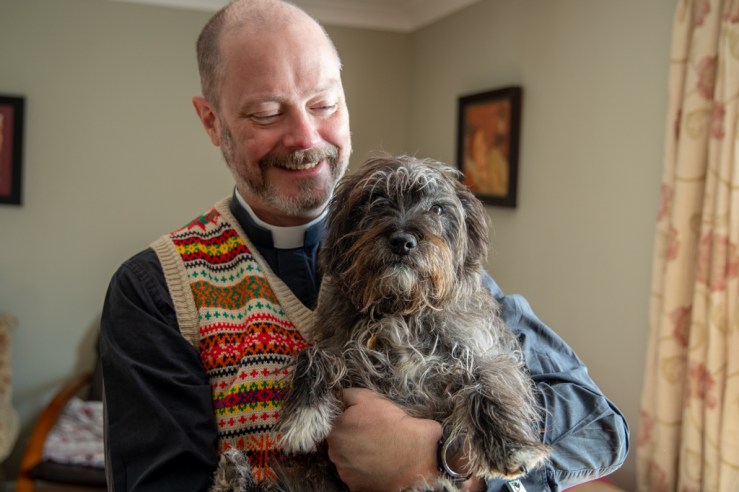
The Reverend Nick Morgan, MA, Vicar of Walton
How to support St Peter’s Church

THE PARISH GIVING SCHEME
The Parish Giving Scheme allows you to set up regular giving, or to make one off payments. Visit their website www.parishgiving.org.uk and search for us there using your own postcode, then select St Peter’s, Walton,
or use the QR code (to the right).
or simply call 0333 002 1260 and a friendly operator will talk you through the process. Our Parish Giving Scheme reference number is 430643175 and our postcode is LS23 7DJ.
ANNUAL LUMP SUM DONATIONS
You might consider committing to give an annual lump sum to support St Peter’s, perhaps towards the end of each tax year, or when you receive annual dividends. If this is the case, please contact our treasurer Fiona Robinson fionarob@outlook.com to let her know how much you would like to pledge each year. This will help us budget and know we can meet our financial commitments and Fiona will tell you how to arrange these payments.
STANDING ORDERS?
If you already have a standing order to St Peter’s Church, please consider transferring your planned giving to the Parish Giving Scheme. The benefits of this scheme are:
- you have the Direct Debit guarantee to safeguard your payments
- each year it gives the option of increasing your payments in line with inflation which helps future-proof our budgeting. This increase is never done automatically – only on your say so.
ONE-OFF GIFTS
If you would like to make a one-off gift to St Peter’s Church
please make cheques payable to: St Peter’s Church, Walton,
or make a Bank Transfer to: St Peters church Walton 55-81-11 03626237
or contact our Treasurer, Fiona Robinson – fionarob@outlook.com

St Peter’s Church, Walton, in the Diocese of York
Loving and serving the village of Walton since 1350AD and committed to keeping our heartbeat of love, regular prayer and worship going in our village into the future.
Magnificat: a call to justice and peace
SERMON given at St Mary’s Church, Boston Spa on Sunday 22nd December 2024 – Advent 4
Trigger warning: includes references to the Gisèle Pelicot case and Safeguarding failures in the Church of England
Readings: Micah 5:2-5a and Luke 1:39-55
Few can fail to admire Gisèle Pelicot whose bravery in waiving her right to anonymity and speaking out publicly has not only brought her justice for herself, but has blown the secrecy surrounding a culture of abuse, the full scale of which is not yet apparent. What an amazing woman, to step into the public gaze in these circumstances and bring into the light, malevolent acts veiled in darkness. Her voice has been heard, and the world is the better for it.
There is in any society a problem of privileging some voices over others. It is a problem because those with power are heard most. Elon Musk uses his wealth to amplify the voices of the rich and powerful to political ends. The UK media is selective in which politicians it gives air time and column inches to, with a preference towards the forces of power, populism and wealth. Part of the problem with historic cases of abuse in the Church of England has been a lack of willingness to challenge those in positions of privilege who are used to always being heard and respected. Those we now know to be abusers who operated within the Church of England were invariably confident, charismatic, well-connected men who were listened to, and used to being listened to, often uncritically, whose reputations were prioritized, and whose ministries were underpinned by a warped theology which reinforces inequality, exclusion and privilege. The voices of their victims were for too many years not heard, and the structures of the Church of England, historically, have worked against transparency and justice. Not all voices are equal in this world, and the Church of England must urgently get better at hearing the voices of victims of abuse, and the prophetic voices of those who are too often overlooked. This is not simply a trendy, contemporary matter: the Bible is littered with unlikely voices – voices of the powerless, the overlooked, the unlikely and the marginal through whom God spoke with great power. Abraham and Sarah, the unlikely elderly first time parents. Jacob the liar. Moses the stutterer. Ruth the Moabite woman. David the shepherd boy. Unlikely folk who were all key parts of the tale which leads to the birth of Jesus. And indeed that is how the message of the birth of Jesus came to us: unlikely voices of great significance.
Our Gospel reading centres on two amazing women: Elizabeth and Mary, each of whom is faced with life in a mess. Elizabeth has been childless but has unexpectedly become pregnant at a time of life when she thought this was impossible. Added to that, her husband is suddenly rendered mute, unable to speak. At the arrival of her relative, Mary, the baby within her leaps for joy and she is filled with the Holy Spirit. The whole situation is Inconvenient, Messy, and Weird. Then there’s Mary, who was visited by an angel – a hugely disruptive event in which she was told amazing news that she is to bear God’s Son and who reacted by saying “Yes” to God. Her life is turned upside down, and here she is visiting her relative, Elizabeth. These women’s lives are in a state of mess. Things are not as they imagined, this is not the life they had planned, but they each have a sense that they are part of something bigger than themselves.
So if anyone ever tells you that politics and religion should never be mixed, just point them to Mary’s words. We sing or say them in church as the Magnificat, regularly as part of Evensong and their familiarity can, I think, lead us to ignore how radical these words truly are. This young woman, faced with her life being turned upside down, faced with a pregnancy which is potentially socially shameful, faced with the astonishing weirdness of an angelic message that she is to be the God-bearer, she responds by rejoicing in God her Saviour. She acknowledges her lowliness before the holiness and mightiness of God; she exults in the way in which God promises to turn the power dynamics of the world upside down, to mess up the grand plans of humanity, to cast down the mighty, to exalt the humble and meek, to feed the hungry and leave the rich to their own devices, and in this Mary sees through the mess of her own circumstances to God fulfilling the promise to Abraham and the people of Israel through her and through the chaos of her life.
Christmas can be a disruptive time, a time of mess. Perhaps it’s a time of inconvenient journeys to see loved ones. A time of making up spare rooms and preparing for grandchildren to scatter paper and toys around your house. Maybe it’s a time of remembering loved ones who are no longer here to be with us around the table for Christmas dinner. For some, it’s a time of feeling pressure to spend more than we should, to do things we really have no energy for. Or a time of being rejected by members of your own family, perhaps. It can be messy. But the mess of our lives is what Jesus came to get involved in. The love of God was not revealed by an authoritative voice of privilege: not through a charismatic religious leader used to being heard unchallenged. Not a priest, prophet or king. The love of God was enfleshed among us through an unregarded, young woman who said “Yes” to God; who spoke prophetically to an audience of just a single, similarly unimportant, overlooked woman in words which resonate today; whose words welcoming God’s justice and peace we do well to echo.
The Church of England has to be ready to listen and respond to those who bravely step up to bring dark matters to light. We owe them the justice and peace of Christ in the way we respond to the abuse they endured. This is a matter of behaving prophetically and saying “Yes” to the justice of God which Mary said yes to, inconvenient and uncomfortable as it was for her to do so.
And you and me, as we prepare for Christmas, we need to ask whether we are ready to hear the voice of God in unexpected places. Are we ready to listen to the voices of the overlooked, the unimportant and expect to encounter the love of God through them? Are we ready to invite God into our hearts afresh, into lives which are not perfect, and parts of which are doubtless still messy? Like Mary, let us be ready to rejoice when God shakes our lives up. Let’s be ready to say yes to God, as Mary did, and to be bearers of Christ ourselves as we take the light of Christ into the mess of the world. Like Mary and Elizabeth, we are called to be prophets who welcome and rejoice in the justice and peace of God. May it be so. Amen.
A day in the life…
One thing after another
On the morning of Her Majesty’s Funeral
An improvised poem, spontaneously devised and recorded as I prepared St Mary’s, Boston Spa to livestream the State Funeral of Her Majesty Queen Elizabeth II
You are the light
When Archbishop Desmond Tutu died at Christmas 2021, we lost someone who truly shone the light of Christ into the world. I wrote a song, based on some of the words of Jesus from Matthew’s Gospel which are appropriate for Epiphany, and for remembering Archbishop Tutu, one of those people who really was a light on a hill.
Jesus said, “You are the light of the world. A city built on a hill cannot be hidden. No one after lighting a lamp puts it under the bushel basket, but on the lampstand, and it gives light to all in the house. In the same way, let your light shine before others, so that they may see your good works and give glory to your Father in heaven.”
Matthew 5:14-16
Stones at a Remove
Stones at a Remove
A standing stone,
Place of gathering,
Landmark on a hill.
A place seen from far off:
Somewhere to aim for.
Speaking of more than stone,
Being more than a beacon:
Emblem of companionship,
Presence of encouragement
On faith’s journey.
Articulating rootedness:
Community of ages,
Speaking of destination
Even to those
Not knowingly on that journey.
Icon of Light.
Sign of Christ.
Agent of the Holy Spirit.
Virtually visible
Yet literally present
Where utterance enters heart;
Where conversations continue;
Where God’s love and relationships bloom.
Witness to life in Christ,
Inviting a threshold-crossing
Into standing in the flesh
Among living stones
Who continue to build, be built and to bless.
A standing stone,
Place of gathering,
Landmark on a hill.
A place seen from far off:
Somewhere to encounter God.
written 6th June 2015, Upper Church, Community of the Resurrection, Mirfield
I wrote this poem for Sian Lawton as she took on my former role as Ripon Cathedral’s online ministry co-ordinator back in 2015, but here in 2021 it has fresh resonance with the post-lockdown importance of renewing our ministry in church buildings.
It is a reflection on the complementary nature of online and church building-based ministry and worship. The standing stone refers to the Anglo Saxon gathering stone in the churchyard at Ripon (near its southwest corner, and which looks like a spent match) – an ancient place to gather in worship, but a very different expression of gathered worship to even what went on in St Wilfrid’s 7th century church on this site. Places and forms of worship evolve.
Online church, and the church building have in the poem the same role, and are guided by the same Spirit.
Dust, recycled
I’ve been preparing the ashes for Ash Wednesday this afternoon. It’s quite an interesting process (at least, The Dog™ thought so as he supervised).
How to prepare ashes for Ash Wednesday…
- Collect in the palm crosses from last year from folk at church.
- Bake them (the crosses, not the folk at church) at 220 degrees centigrade for half an hour or so. This burns off the oils in the leaves so that they will burn to ashes when you start getting serious about burning them in step 3.
- Get serious about burning the palm crosses. In my case, this involved snipping them up, putting them in a foil tray out of the recycling, then setting about them with a kitchen blowtorch outside.
- Once they are pretty comprehensively burnt, grind them with a mortar and pestle.
- Add olive oil and stir it really well so the ash is mixed in completely.
- Pour it into a handy glass jar from the recycling.












Do not be afraid? That’s easy for you to say, Mr. Archangel

Whoever wields political power, the job of the Church remains much the same. We just have to work out where to put our energies in order to be faithful to our calling in whatever political landscape we find ourselves. Like Mary, we are called to be God-bearers in the world: to bear the light of Christ and give birth to hope. Like the angel alarmingly yelling at shepherds on a hill out of the blue, we have to somehow make “Do not be afraid!” into more than empty bellowings into the dark night and overcome perfectly legitimate fear with the heavenly host’s message of love: glory to God and peace on earth. Then, like they did, we need to point our listeners in the direction of Jesus, the reason for that reassurance.
And that’s a tough gig. It has to be more than empty words. We have to live the hope that is revealed in Jesus, and be active messengers of hope to those who today are despairing. This means feeding the hungry, healing the sick, comforting those who mourn (Isaiah), regarding the lowly, scattering the proud, thwarting the self-serving agendas of the mighty, exalting the humble and meek (Mary), pursuing truth and justice, loving mercy, walking with God in a humble way which means our own agenda has to take a back seat (Micah), being good news to the poor, proclaiming liberty to the captives (Jesus) and so on (see the Bible for more of this kind of thing).
And yes, it means continuing to pray for all in authority, not to bestow upon them our approval, and certainly not to give them any sense that their every action has a divine seal of approval, or is somehow ‘God’s will’. Rather we pray knowing that the way in which human power is used has spiritual and moral significance. We pray because God’s agenda matters and those who govern are answerable to the One who is the source of all power. We pray to hold to account, and as a reminder that, at the end of the day, there is no fridge in which those who govern can hide from God.

God is with us: God’s love is loose in the world in Christ.
Therefore, do not be afraid.
But if you are, you’re not alone: God is with you, and, if we’re doing our job, then the Church is with you too.
May it be so. Amen.
 Vicar of Villages