The Book of Psalms:
#46: 1-3
Flourishing depends on having the right conditions, as all good gardeners know. Do we have what we need to thrive?

One man and his dog reflect on the whole "being a Christian" thing.
Flourishing depends on having the right conditions, as all good gardeners know. Do we have what we need to thrive?
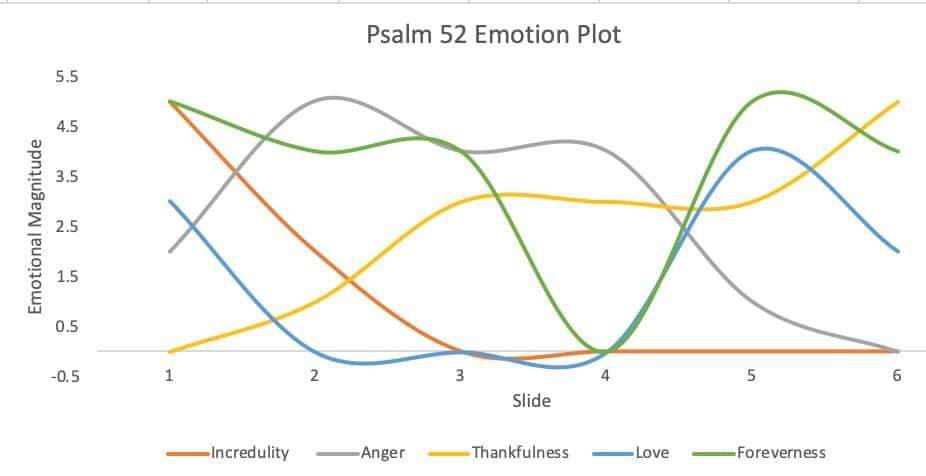
Many thanks to Tim Jackson for the following infographic.
I walked and prayed around the edges of the Holy Island of Lindisfarne whilst on retreat. I did this twice: Anticlockwise one day, then Clockwise another. Here are some ponderings on my first circumnavigation.
 As you can see from the plot of my route, tracked on my phone, this walk traced the outline of a dinosaur with ears. Despite appearances, I did not actually walk on water: this was carefully timed against the tides, but more on that later. I did a lot of singing and praying as I went, and a lot of simply enjoying the view.
Some reflections, then.
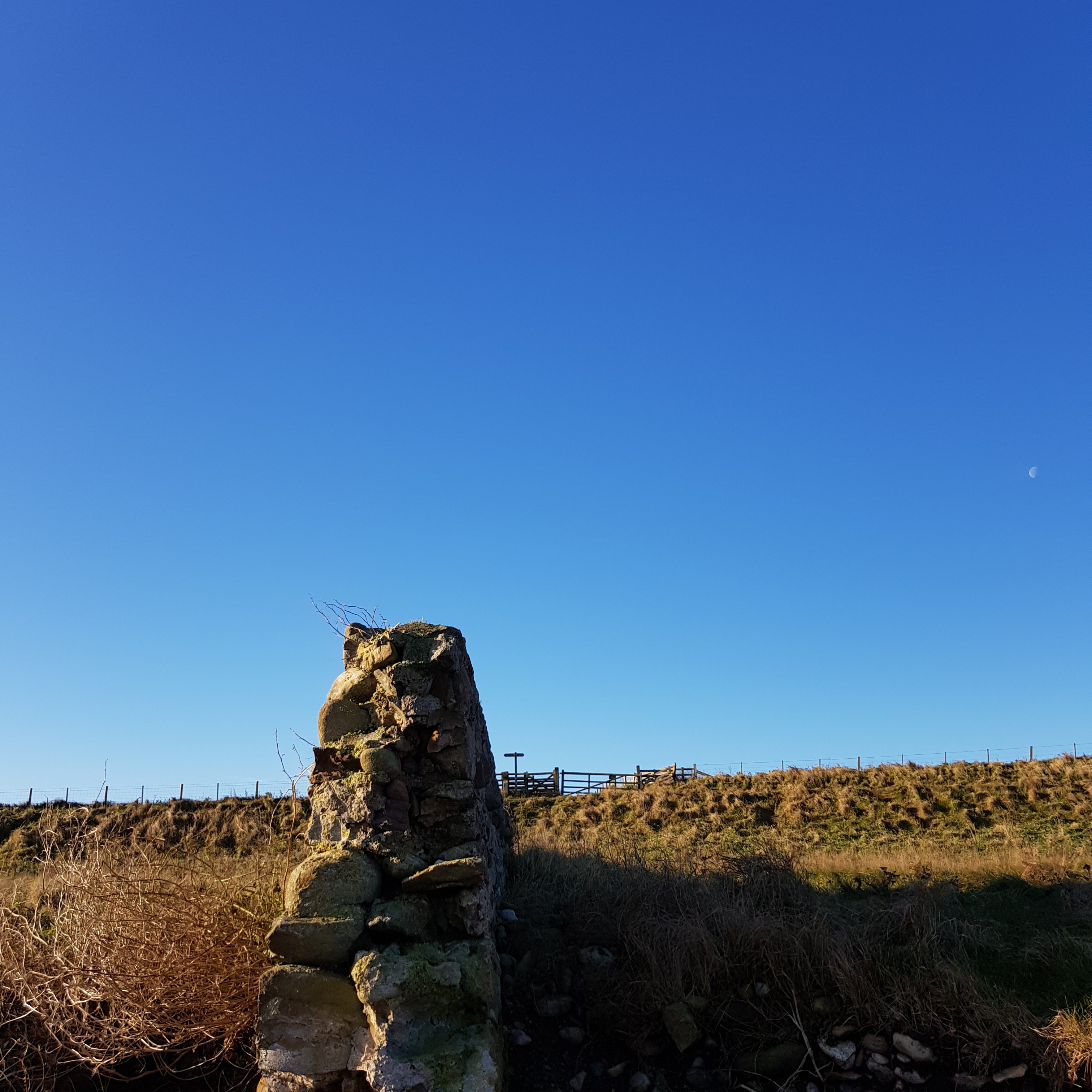 A signpost, too far away to read, but it’s clear that it is pointing where I want to go. It is not only through words that God speaks to us and directs us, and that was certainly true on this walk.
 An alien shape amid a natural landscape says DANGER to passing ships and helps them navigate. The Word of God does much the same: if we keep our eyes on Jesus, the Word Made Flesh, and let that other expression of God’s Word, the Bible, be our guide, our lives can avoid danger and we are then open to the Holy Spirit to be our navigator through life.

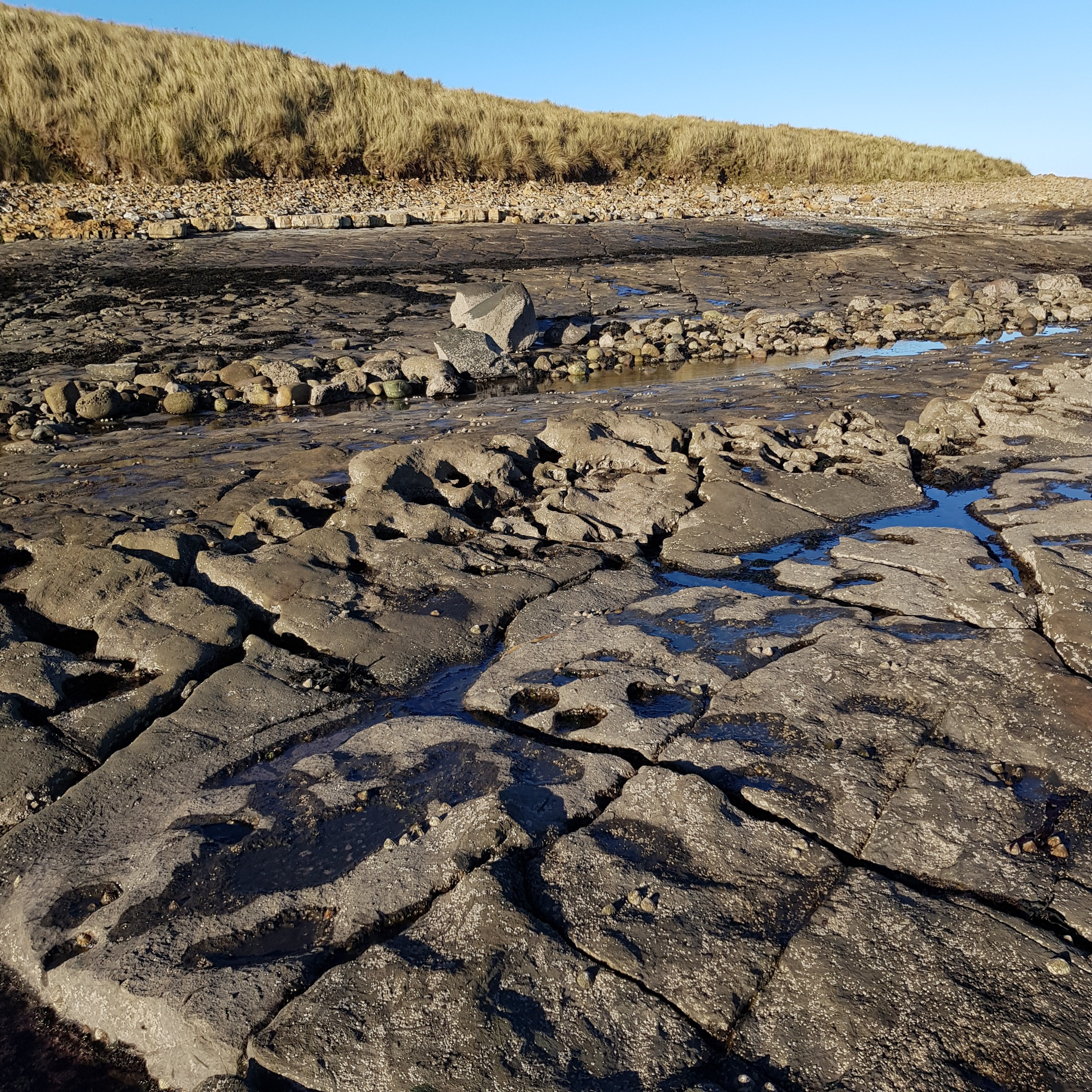
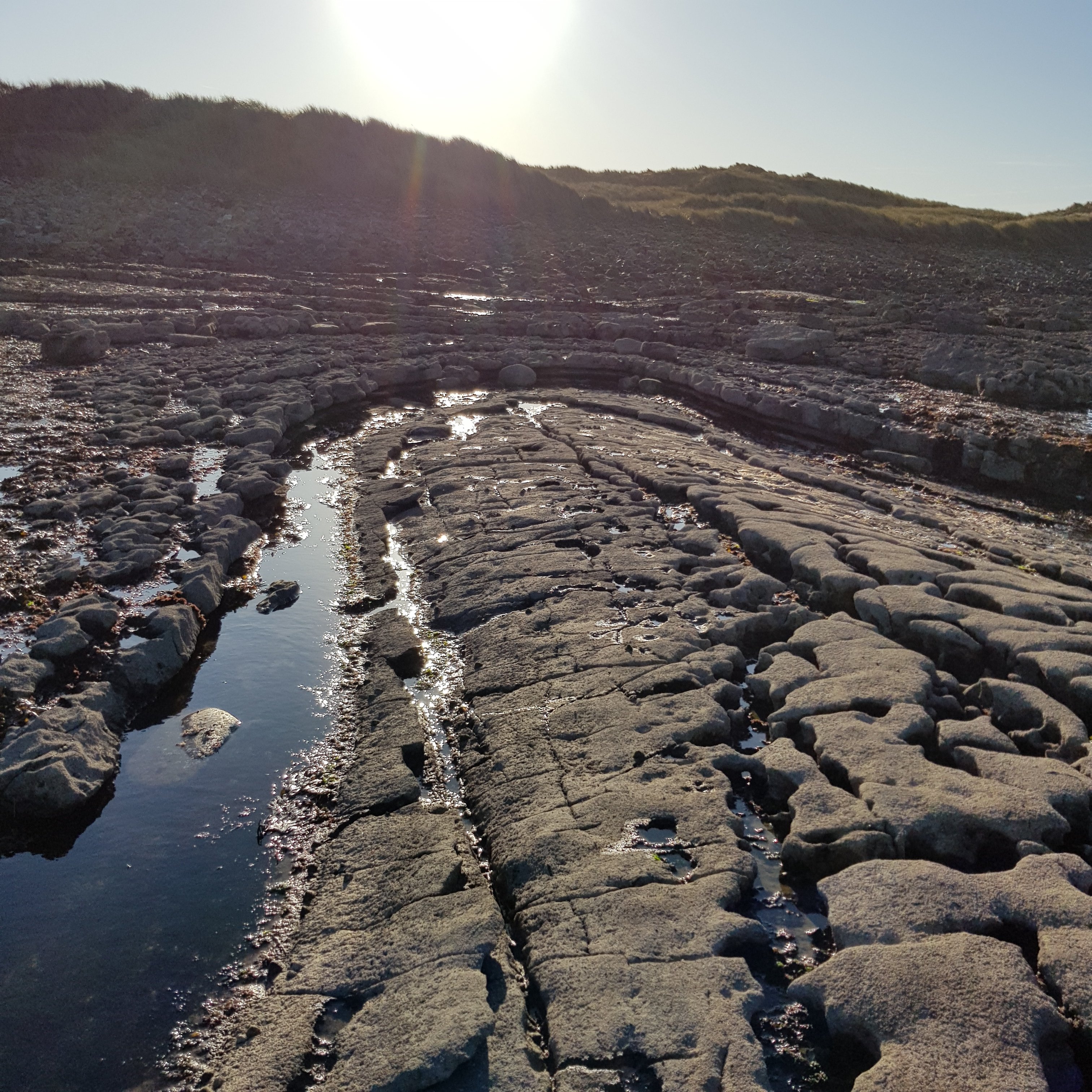 Weathered rocks tell an ancient story, and almost look like architectural remains of a lost civilization. Their beauty can be readily appreciated, but to understand how this landscape came to be takes scientific understanding, geological knowledge and the ability to see and imagine things beyond our limited, human timeframe and personal experience.
The Bible tells a story on a vast, eternal timescale, beyond even geological time. We need to make a similar leap of imagination to learn what God is up to, and how our lives and experiences fit in.
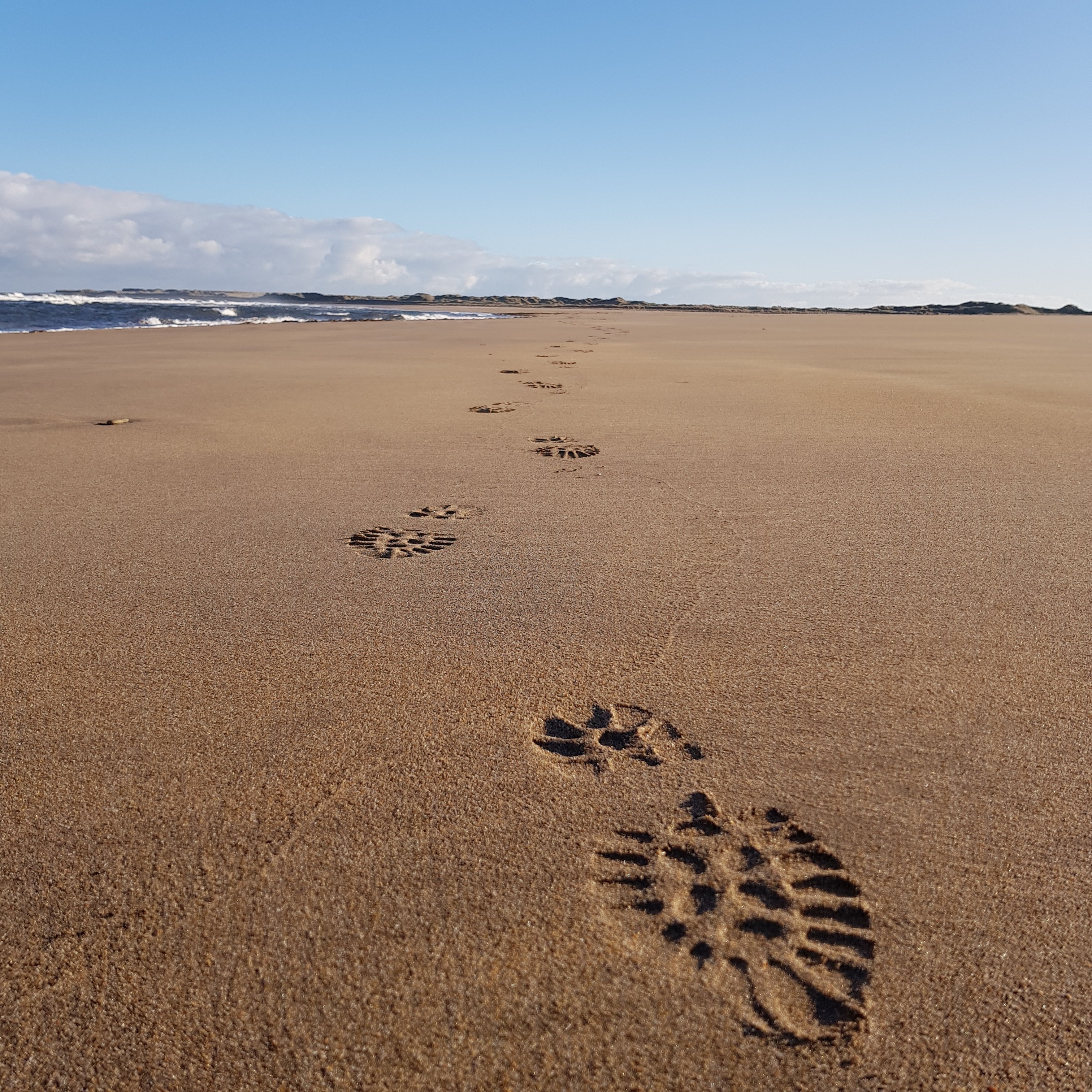
 …and performed an act of faith.
 Looking at the map alone, you could be forgiven for thinking I was miraculously walking on water. As Jesus once pointed out to Peter, we need to keep our eyes on Jesus and trust him if we really want to thrive in faith.
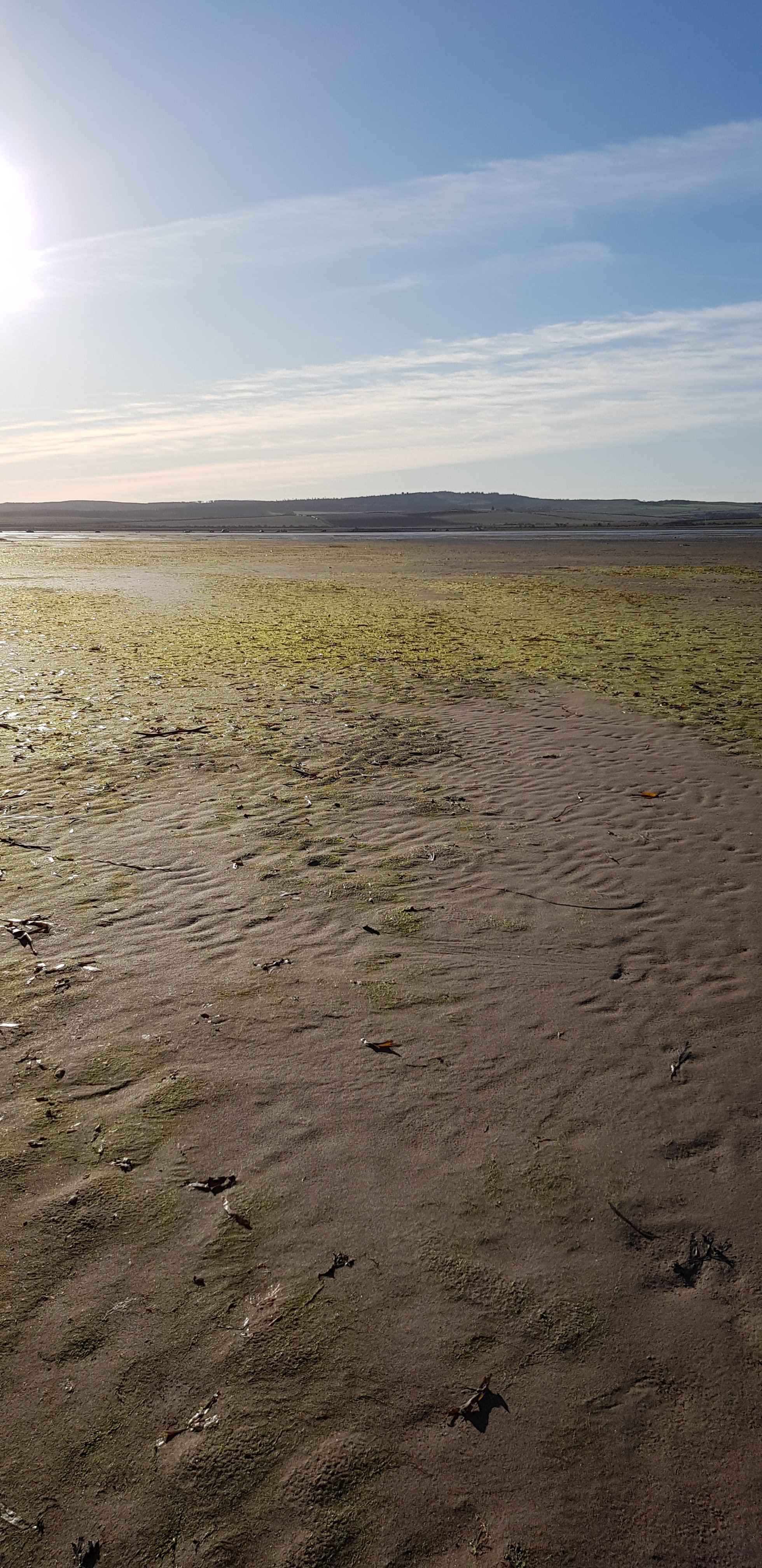 Seeing the tide was now coming in, I hurried back towards the shore to avoid getting cut off on a sand bank (hence drawing the ‘ear’ of a dinosaur on my route plot!). I rounded the western tip of the island and then walked along the causeway road before finding a path into the dunes.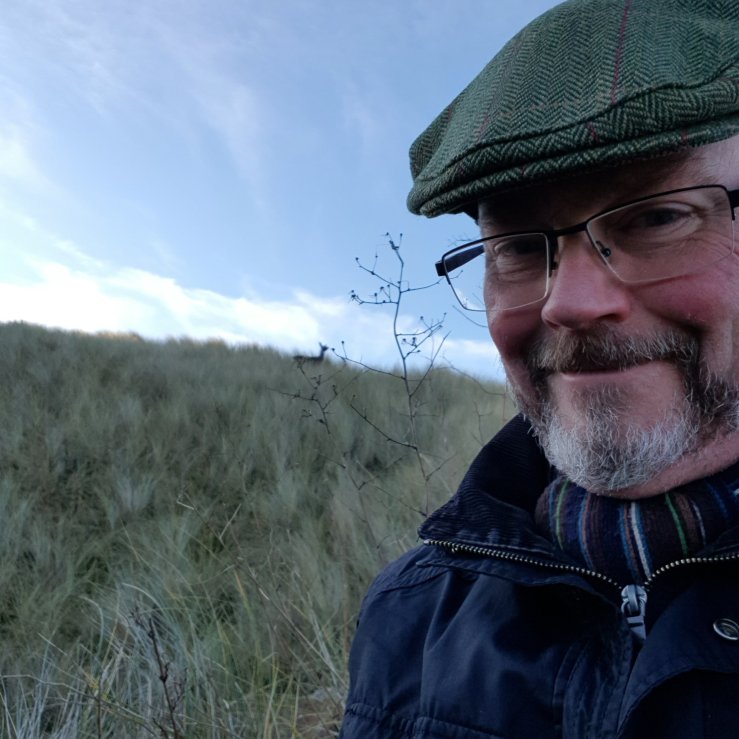
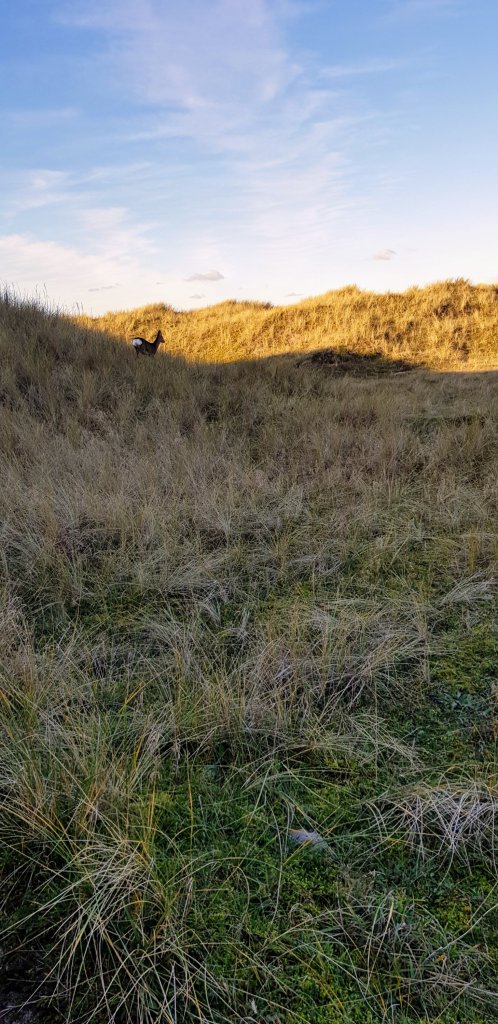
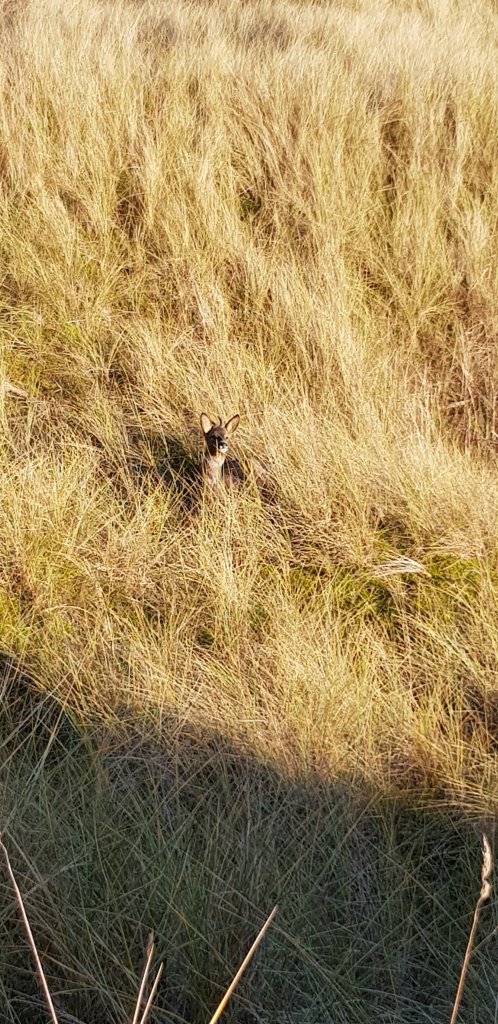
I was on a deer’s turf. I drank soup as it watched me and slowly walked around me. I did not belong there and was making the deer uncomfortable, so I slowly walked on.
It was a magical encounter.
I walked on back to the Crown and Anchor for a refreshing pint of something local, full of visions of peace, and the experience of natural beauty.
I pondered Psalm 19 over a pint, a psalm whose last verse I usually use as a prayer before I preach. That psalm reminds us that the wonders of the natural world speak of God, as does the Word of God – that is, scripture. If our hearts and minds are set on God, we navigate life as we should in a way which leads us to flourish.
Readings: Revelation 21:1-7 John 15:12-17
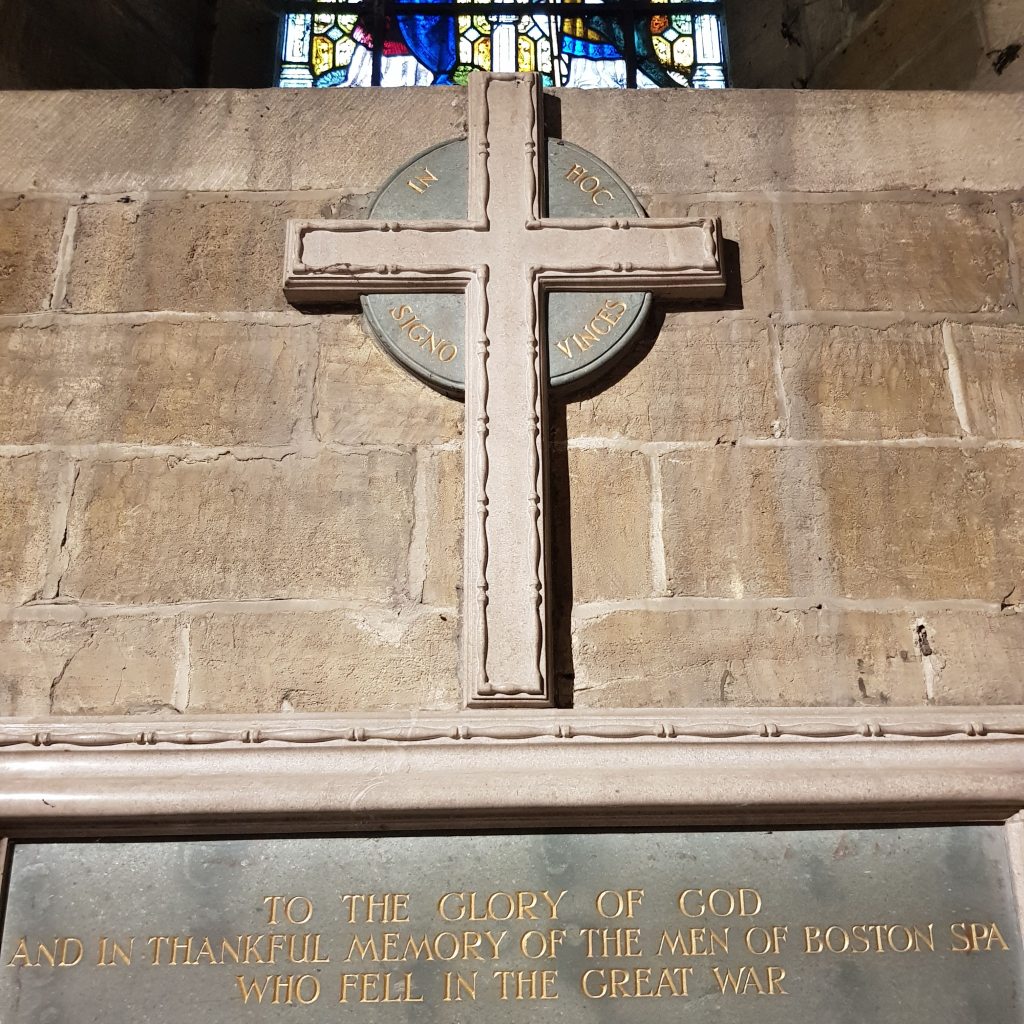
Today we pause for two minutes’ silence marking the Armistice, the end of the Great War, and gather all around the country and the commonwealth in remembrance of those who in two world wars (and in subsequent wars and conflicts) have paid the ultimate price for peace, as well as those whose lives, bodies and minds have been dramatically changed through their service in our armed forces. It is right and proper to look back with gratitude to those who lost their lives in conflicts. Some of you here today may have very personal reasons for doing so, and it is our honour to stand alongside you as you remember friends, comrades, and perhaps family members. You are not alone: we will remember, with you.
That is one aspect of Remembrance Sunday which will be focused upon later in this service, and again at the village war memorial, and it is a crucial aspect. But there is another, and that is to reflect on the sins of the world (that is to say, the many reasons for war and violent conflict), and to commit ourselves to peace. We cannot ever become so comfortable or complacent that we take peace for granted, either internationally, or even within our own nation. It is part and parcel of the human condition that nations “furiously rage together” as the Psalmist puts it.

Often this is the result of worldviews being in conflict: of opposing visions of the future. Visions in which national boundaries are defined in different ways; or how political settlements between regions, or nations are envisaged. Differing visions of access to resources; visions of different religions dominating politically – though this is statistically much rarer as a cause of war than one is often led to believe. The way we see the world, our vision of what the future ought to hold, is important. It is the job not only of politicians, but of all of us, to keep our eye on the ball: to look not only at the international situation, but also to look at our own nation with a self-critical eye and question where our future lies – to question our vision of ourselves and our own country.
The current General Election campaign brings this into sharp focus, and we should be questioning those who would have us vote for them, and indeed question ourselves: what is our vision for the future of our country? And we need to question ourselves honestly, because the vision which emerges in a society comes from within us: it comes from the human heart. George Orwell, in his essay “Freedom of the Park” (in 1945) wrote this: “…the relative freedom which we enjoy depends on public opinion. The law is no protection. Governments make laws, but whether they are carried out, and how the police behave, depends on the general temper of the country. If large numbers of people are interested in freedom of speech, there will be freedom of speech, even if the law forbids it; if public opinion is sluggish, inconvenient minorities will be persecuted, even if laws exist to protect them.” These remain, sadly, prophetic words. Where are our hearts leading us? What is our vision?
This is about the values which inform and underpin our communal life as human beings who have to share the world and its resources. If those are not God’s values, not God’s vision, then true peace will not reign on earth. As Jesus said to Pilate at his trial “My kingdom is not of this world.” So, when we look to visions of God’s Kingdom in the Bible, we are not reading a political manifesto, but we are getting a glimpse of what the eternal Kingdom of God will eventually look like. John the Divine, who wrote the Book of Revelation which we heard from in our first reading, tells us about the world being recreated as its maker intended. It’s a vision of God’s rule: a new creation in which the nations of the earth are no more and are replaced with God’s holy city: a new Jerusalem coming down from heaven. God’s holy city is something we are called to look towards: a far bigger vision than any national vision. And if our churches, our village, our nation and our world is to gain that vision, the hearts of people need to be turned towards God. Seeing ourselves in our proper perspective, with humility before the authority of God – that is what is needed.

Often, conflict is the result of human vanity and arrogance. The Bible’s vision is of humanity knowing that God is the only true authority and placing itself under God’s rule. If all humanity had God’s heart and saw the world through God’s eyes, there would be no wars.
We are called to abide in the love of Jesus, just as Jesus abides in the Father’s love. We are called to love one another as Jesus has loved us – even to the point of laying down his life for us. That is the vision we aspire to.
Every nation is led by the vision its people allow to flourish. Where a nation has a flawed or evil vision, God’s people are called to challenge it. We are all led by what lies in our hearts, and if we are serious about wanting peace in the world, we should start by asking God to change our own hearts by inviting Jesus into our lives to transform us by the power of the Holy Spirit. You, me, us. Abiding in the love of Jesus.
Our vision needs to be big. Massive. A world vision to match God’s. A vision which unfolds locally, here in Boston Spa. A vision which starts in each of our hearts, but which looks outward, and spreads generously, lavishly, just like God’s love. Just as we are called to abide in the love of Jesus, just as Jesus abides in the love of God the Father, so must the world abide in our love. That is the legacy we should seek for those who have given their lives in the service of our nation in the hope of peace: that we become people, and are part of a nation and international community which walks in God’s ways and abides in God’s love. God’s generous, lavish love. May peace and love flourish among us. Amen.

“Learn the lesson that, if you are to do the work of a prophet, what you need is not a sceptre but a hoe.”
— Bernard of Clairvaux
What follows was written a good few years ago, but as my first post of this new blog, I hope it gives some idea as to why this site exists, and why I bother to put things on t’internet at all.
Social media has many uses and offers many ways of using our voices. It’s interesting thinking about churches and Christian organisations I follow on Twitter, Instagram and Facebook. Some read pretty much like a newsletter, telling me of events or campaigns, and perhaps asking for prayers for particular ministries. Others add actual prayers or liturgy, while relatively few link to resources I might find useful and things I might be tempted to interact with. Even fewer regularly promote things going on in their wider community outside church activities, ministries, theology and news of interest only to those already involved in the Church. As someone who’s long been involved in online ministry (as well as being active in ministry in the flesh, I hasten to add), I’ve been grappling with this: how does this look from the outside, and am I missing a trick here?
So… what’s a prophet?
The work of a prophet involves calling people to God. I think there is a challenge here for anyone who is seeking to have an effective online ministry. Not everyone is called to the work of a prophet, but I am not entirely convinced that I see much of this kind of ministry being done by individual churches online , and not in a way which engages people. I may be wrong! Do tell me in comments if I’ve overlooked what you are doing – I’d love to promote it, be encouraged by it and celebrate it. However, at the risk of re-inventing this particular wheel, here are my thoughts on how to meet this challenge of calling people to God through how we use social media. To use Bernard of Clairvaux’s words, this means relying less on appearing regal and authoritative (wielding a royal sceptre) and more on actually working alongside people, sharing their lives, concerns and needs and preparing the earth for sowing by hoeing. The resurrected Christ was mistaken for a gardener, so I rather like this image of Jesus offering to equip me with a hoe rather than a sceptre. This also chimes with Jesus’s example of washing his disciples’ feet and telling them to do the same.
A question then: when someone sees my online ministry over time, how would they see Jesus the servant King, holding a towel to wipe his disciples’ feet, reflected in it?
This is quite a challenge, and especially tricky I think if you are representing your church or organisation via social media. How do we call people to God, how do we make the ground ready, how do we work alongside those we want proclaim Christ to? Because our online presence is technically global, I think the local impact of our worldwide-online presence can sometimes get overlooked.
Some ideas, then, tailored mainly for church groups, and mainly aimed at the impact on communities locally.
Promote other events in your community
As well as your own events and news, ReTweet and Share things not related to your church but which will serve your community. Become known as a hub of positive news about where you live and show that your church cares about what happens locally.
Encourage others locally
As well as a Share or ReTweet of other groups events and news, comment, congratulate, commiserate, encourage and engage.
Engage in the local conversations
Even if there is a contentious issue which might not be wise to get your church too closely associated with, or seen as being on one side or the other, how about posting that you are praying for all concerned? It might not always be appropriate, but it’s worth considering letting people know that you are engaging in prayer and are concerned for the people caught up in an issue.
Be part of the bigger picture
Consider whether you might become part of a local hub to promote your community and events in general. Talk to your town/parish council and other groups and, if you are the organisation with the most web traffic, find ways to use your online resources as part of a bigger local picture. Just as some rural churches have housed local post offices, shops and council leaflets, perhaps you could become the online place to come for information of all kinds. Be generous in sharing your online resources, impact and goodwill. This isn’t about hijacking other groups’ traffic or of diluting your online presence: it’s about the church being engaged fully in local life and tilling the earth alongside its neighbours.
Risk and Reward
There are pitfalls and risks in all the above. I sometimes worry that I may accidentally end up associating my church with something it would not wish to by a careless Tweet. The answer lies in not Tweeting carelessly, of course… and in prayerfully developing a strategy for how to present our church online. And here is revealed one of the secrets: it is very hard for an organisation to be a prophet. Social media by its nature lends itself better, in my experience, to people interacting than organisations. Fortunately, then, God calls people rather than organisations to do the work of prophets. In other words, bring something of yourself to the mix. Invest yourself and don’t be too afraid to do that. Take risks prayerfully and you’ll find that when your Church comes to prophetically call your community to the Lord, the ground is tilled and ready to receive God’s Word. And perhaps your community will hear.
 Vicar of Villages