Creation in Christ, Sunday 6th September 2026
Collect: O God and Father of all that was, is and ever shall be, help us to be thankful for all that is made at the hands of your Son and through the wisdom of your Spirit, that we may care in heart and in deed for the life of our world, to the praise and glory of your holy name.
Post Communion: God our Creator, by your gift the tree of life was set at the heart of the earthly paradise, and the bread of life at the heart of your Church: may we who have been nourished at your table on earth be transformed by the glory of the Saviour’s cross and enjoy the delights of eternity; through Jesus Christ our Lord.
Isaiah 55.12–end For you shall go out in joy, and be led back in peace; the mountains and the hills before you shall burst into song, and all the trees of the field shall clap their hands. 13 Instead of the thorn shall come up the cypress; instead of the brier shall come up the myrtle; and it shall be to the Lord for a memorial, for an everlasting sign that shall not be cut off. [New Revised Standard Version]
John 1.1–14 In the beginning was the Word, and the Word was with God, and the Word was God. 2He was in the beginning with God. 3All things came into being through him, and without him not one thing came into being. What has come into being 4in him was life, and the life was the light of all people. 5The light shines in the darkness, and the darkness did not overcome it.
6 There was a man sent from God, whose name was John. 7He came as a witness to testify to the light, so that all might believe through him. 8He himself was not the light, but he came to testify to the light. 9The true light, which enlightens everyone, was coming into the world.
10 He was in the world, and the world came into being through him; yet the world did not know him. 11He came to what was his own, and his own people did not accept him. 12But to all who received him, who believed in his name, he gave power to become children of God, 13who were born, not of blood or of the will of the flesh or of the will of man, but of God.
14 And the Word became flesh and lived among us, and we have seen his glory, the glory as of a father’s only son, full of grace and truth. [New Revised Standard Version]
Sermon
There has been a colour pallete to this summer that none of us will forget in a hurry: the brown of baked earth, the brittle, straw coloured grass that gave up weeks ago, hedgerows going thorny and grey rather than green, and beige fields so tinder-dry that farmers have watched them with desperation. And then, in the past week or so, thunder, rain, and, almost overnight, green shoots pushing up through ground that looked as though it had forgotten how to grow anything at all. Wonderful to see, but too late for the harvest that should have been standing in fields by now. The green has come back a little, but the growing season that desperately needed the rain has already gone.
That mixture of relief and grief really resonates with the end of our reading from Isaiah this morning, because it is exactly the landscape Isaiah is describing: land that has been through something hard, and comes out the other side changed, and green, and singing. Instead of the thorn, the cypress will come forth; instead of the brier, the myrtle will come up, and it will stand as a sign, for ever, a sign that will not be cut off. A few verses earlier, Isaiah has told us the source of this hope and renewal: God’s word, once spoken, does not return empty; it accomplishes what it was sent to do, the way rain waters the earth and makes it productive.
And in our Gospel reading, John tells us that this word has a name and a face. In the beginning was the Word, and the Word was with God, and the Word was God; all things came into being through him, and without him not one thing came into being. He is not simply the one who spoke the world into growing; every cypress and every myrtle, every lawn now turning green again after weeks of dust, exists because of him, and could not exist without him. And then there’s the sentence that changes everything: the Word became flesh, and lived among us, and we have seen his glory, full of grace and truth. This is what no drought-breaking deluge can do on its own. God didn’t simply send rain to our dry ground from a safe distance: God moved in. In Jesus, God pitched his tent among the very people and fields that he had made, to live there, permanently, with us.
Which brings me to the tree, because our post communion prayer today will remind us that at the heart of the earthly paradise, God set a tree of life. What has grown up almost everywhere since is thorn. That is Isaiah’s whole promise in miniature: the thorn is not kept at arm’s length from Jesus. It is woven into a crown, and pressed onto the head of the very one through whom all things were made. The cross is wood. It could, in another story, have been a cypress, or myrtle tree. Instead, it combines thorn and tree together in a single image, and what we find there is not a God who spares us the thorns of this world from a distance, but a God who takes them head on, wears them, suffers those thorns, and prevails over them. That is Isaiah’s promise carried all the way to its most costly point, and that is why our Post Communion prayer can speak of being transformed by the glory of the Saviour’s cross. Glory and cross, in the same breath: this is where the tree of life and the thorn finally meet, and the thorn loses.
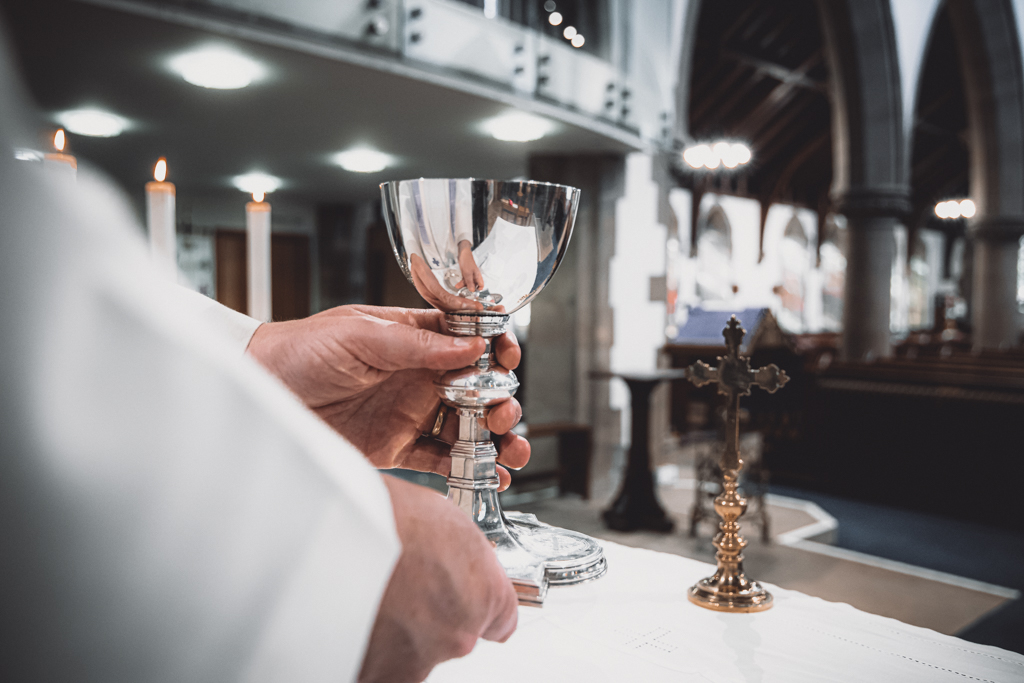
And the Word who pitched his tent among us has not simply struck camp, in the style of Leeds Festival attendees, leaving the mud and mess for others to deal with. He is with us, still. This is what we witness to at this table, week by week: the bread of life is at the heart of the Church, exactly as the tree of life was at the heart of the garden of Eden. We come forward as parched as the grass was a fortnight ago, and we are revived, not because we have earned the rain, but because that is simply what God does with what he has made. Tree, then table, then cross: three places where ordinary created stuff, earth, stone, wood, bread and wine, turns out to be strong enough to carry the whole weight of the story of God’s glory. This is Creation revealing Christ. This is a reflection of Christ who redeems and renews Creation.
I don’t think any of that imagery is given to us to simply admire from a safe distance. If a tree can carry that much glory, and a piece of bread can carry that much glory, and a cup of wine can carry that much glory, and a stone altar table can carry that much glory… then it is very hard to go on treating any part of what God has made – a field, a hedgerow, a river, a person sitting three pews along from you – as though it were simply there for our use or enjoyment and nothing more. Living Christ’s story, or living sacramentally, if I can put it that way, means training ourselves to see everything in Creation as part of God’s revelation in Christ. To notice how much a few weeks without rain can cost a farmer a whole year’s harvest, because that field was never ‘just’ a field; to notice the neighbour who has gone quiet lately, because that person was never ‘just’ a neighbour. We need to let what happens at this table each week retrain how we look at everything else for the rest of it.
This is where sacrament leads into living sacrifice, and I think that is exactly the movement our post communion prayer is tracing when it takes us straight from being nourished at the Lord’s table to being transformed by the glory of the Saviour’s cross. To be fed here is to be shaped, slowly, into people who give themselves away rather than simply take; who care for the life of our world, as our collect puts it, in heart and in deed, and who care just as instinctively for the life sitting next to us in church, the one who is struggling, the one this drought or this year or this life has left thorn-scratched and dry. And that is not a grim calling. The same Jesus who wore the crown of thorns is risen, and it is his risen life that we are grafted into at this table, which is exactly why Isaiah can start the passage we heard today with joy, and why our own hedgerows, thorns and all, are worth stopping to notice this week.
When you walk past one of them in the coming days, and see, alongside all that thorn, the first fresh green the land has managed in weeks, let it preach to you. The green has come too late for this year’s harvest, but never too late for what it stands for. The Word who made every green shoot has already walked through the thorn we live amongst and out the other side, and is feeding us even now with his own risen life, that we might become, in heart and in deed, a green and growing sign of the love of God that will flourish and witness to his glory among us. Amen.


Leave a Reply