
Easter is when we start to see things differently. Everything Jesus said and did suddenly takes on a new light. This is a new era of the barriers which humanity devises being broken down, and the result is redemption. Peter, the one who had denied Jesus three times is redeemed. Our instinct for fairness says he blew it, he can’t be relied on – this alleged “Rock” of faith collapsed into a pile of sand when put under pressure. Yet in the light of the resurrection, all is forgiven, all is restored. He meets the risen Christ and is, once again, the Rock. The disciples who had fled into the night on the Thursday had reason to flee – they would be rounded up as terrorists, the henchmen of this troublesome Jewish would-be-King. How ashamed they must feel come the Resurrection, though: how can they face Jesus, the man they failed? Yet Jesus stands among them, without reproach, and come Pentecost, his words from the Last Supper’s teaching come true: the Comforter, the Spirit of Truth falls upon them, and literally inspires them to lives of immensely courageous faith and loving witness to the risen Christ. This is what redemption looks like.
The women who had faithfully witnessed the crucifixion were also the first to witness the resurrection. Legally and culturally, they were easily dismissed as unreliable witnesses, bearers of an “idle tale” (Luke 24:11) of their dead, failed Messiah. Yet God affirms their value, working past cultural misogyny to tell the Church that women’s voices must be heard, and their experience of the risen Christ cannot be overlooked. God chose to reveal the resurrection through them first, and that is no accident. It should inform us beyond a feminist reading of the text: if God chose a culturally weaker, more excluded and overlooked social group – women – as primary witnesses to the most amazing event of our salvation, that tells us something about how we should see things differently too, and act as a warning against marginalising any groups of people in the Church. We need to welcome, affirm, and be informed by the witness of women, of people from other cultures, of d/Deaf and disabled people, of victims of injustice, of people from working class backgrounds, of LGBTQIA+ people, and any other people who can witness to the power of the risen Christ. This is not a modern re-reading of Scripture: it is hard-wired into the story of our salvation and the mission of God in the world.
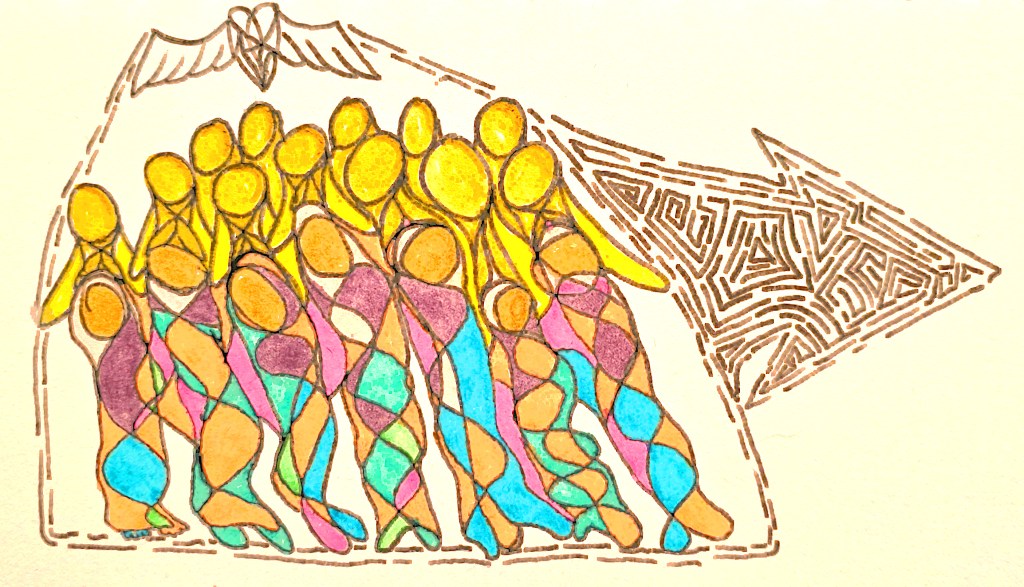
Fast forward to Acts 6:1-7, a passage that has been provoking me a lot recently. The image at the top of this post is a doodle on this text, where the twelve apostles lay hands on, and pray for the seven stewards they are commissioning for ministry. But this is no mere licensing ceremony: the Holy Spirit is involved, and the truth of the diversity of the Church is about to become more clearly apparent. This scene has come about because the twelve apostles face a challenge, an outcome of the Gospel radically breaking down social and cultural barriers. It has transpired that the Church isn’t just a place for believers from a Judean background, and so the way in which believers from other cultures are starting to enrich the whole community of faith means that questions need to be asked about privilege, power, justice and identity.
Widows of Judean believers were there first. They are the cultural default of the first Christian community, and even if they were from different social backgrounds among themselves, theirs is a privileged identity because they are the “people like us” (if the “us” is the twelve apostles). They are Judean followers of Jesus, just like the twelve. But the Good News of Jesus is for everyone, a universal message of salvation for the whole world, and people from cultures beyond Judean Judaism are already coming to faith in Christ and joining the Christian community. But the culture of the Church isn’t keeping pace with this growth. The needs of the widows among these newcomers are not being met and this is not only a clear injustice, it goes against Jesus’ order that people should be able to look at the Church and say “See how they love one another”. (John 13:35) in order to know they are his disciples.
So the apostles commission seven stewards for the purpose of ensuring that provisions for widows are fairly distributed. Some of these seven have Hellenistic, non-Judean names and clearly come from the same community as the widows who are not being treated justly. Representation matters! But more significantly than that, look at what happens next. Once the apostles lay hands upon them and pray over them, the Holy Spirit takes the wheel. Immediately, these empowered, more diverse ministers are inspired by the Spirit to go way beyond being stewards of alms and provisions. The very next verses in chapter 6 see Stephen emerging as a gifted speaker, a powerful evangelist and worker of miracles. And not long after this, another of these commissioned stewards, Philip, preaches and performs signs and wonders in Samaria, taking the Gospel to another distinctive (and often despised and derided) social group, and then converts the Ethiopian eunuch on his way to Gaza. So we have diversity increasing to embrace someone from not only a very different, African, intellectual, and courtly culture, but also from a gender-queer social background! God’s Church is diverse, right from the start.
When it comes to our Easter faith, liberation from human boundaries is fundamental. Christ not only broke the barriers of sin and death on the cross, he proclaimed life in all its fulness – resurrection life – and in doing so, affirmed the love of God to humanity in all our wondrous diversity. In the Easter Gospel we see women liberated from being second class humans and exalted as first witnesses. We see weak, failed friends restored, forgiven and redeemed. And yet humanity has continued to struggle with this liberation, and even in the Church, we have given in to the Spirit of the Age, a spirit of oppression and control, time after time when it comes to wanting to define who is worthy, who counts, and who does not, when it comes to justice, freedom and dignity. Over the centuries, women have struggled to assert their right to exist in so many ways: in the workplace; in sport; as composers and artists; as politicians; as priests and bishops. Despite women such as Phoebe, Junia, Priscilla and Aquila playing leading roles in the first generation of the Church, often deferred to by male leaders, it was not long before men defined the space women were allowed to occupy in the Church, and their leadership role was reduced. Women have always faced limits being placed on how they are to exist, and what space they are allowed to occupy, and in how they are defined in society. And this past week, yet another attack on women came through the courts, with trans women being the latest victim of this unrelenting, sinful, human instinct to define and limit how women may be defined and what space they can occupy in society. This week’s court decision which completely reframes the the Equality Act of 2010 and the Gender Recognition Act of 2004 to exclude protection of trans women has denied these women a space in which to exist in our society. This has not only opened the door to renewed transphobic attacks, it has also put at risk women who do not fit the cultural norm of femininity, or physical appearance. Women who appear, or dress, in a masculine way are now also at increased risk of attack. Women have fought long and hard not to be defined merely on their physical attractiveness, and their right to exist in any way other than to look pretty to men is once again under threat. Together with other disturbing trends in our society, including rising cases of misogyny, and acts of violence against women, this is the exact opposite of resurrection life, and life in all its fulness. It is an offence against the flourishing to eternal life which the resurrection proclaims and for which the Church is called to strive: to make things on earth as it is in heaven. It is sinful.
I am only a man, but I think I can understand how women have been persuaded that trans women are a threat to them by the strident voices we have heard so much of in the media. Women’s rights have always been under threat, and there have always been attempts to limit women and the space in society they occupy, and yes, as the Gospel tells us, to dismiss their concerns and reports of things that have happened to them as “an idle tale”. This week’s court ruling may seem welcome to some women who fear their space is threatened – I do get that, and there has been a sustained media narrative to that effect. But I do not agree, as the very real threat to women comes overwhelmingly from predatory men posing as trans women, not trans people themselves. This week was not a win for women, in my view – though I am happy to listen to women who can offer the witness of their own experiences to better inform my own male privilege. I am mindful today that the resurrection of Jesus teaches us that women matter and are welcome as equals in the Kingdom of God, not as an afterthought, but as a fundamental Easter truth. But people who matter, who are fundamental to our life in Christ also include people who look odd, who don’t fit in and are not “people like us” – people like the Ethiopian eunuch, people like the Hellenistic widows, or the Samaritans who in the world’s terms were outsiders, but in the Kingdom of God are beloved children, called to resurrection life – life in all its fulness. When we stand in the way of their flourishing, we stand in the way of the Mission of God.
So as a simple follower of Jesus, and as a child of the resurrection, I stand this Easter Day with trans people, with the beleaguered gender queer children of God. I stand with the women who are fearful, who don’t feel listened to. I stand with those who feel they don’t belong, those who cannot see a welcome place for them in society or the Church, and I pull out a chair at the Lord’s table and say, “Sit by me, you belong as much as I do. Let’s eat and drink richly together, and let’s talk about what we both know of the wonder and love of Jesus, who died for us both, and who lives in you and me today, and came, and died, and rose again so that we all might flourish as God’s children.”.
May it be so. Amen.
 Vicar of Villages